Study led with major contributions from the Laboratoire des Sciences du Climat et de l’Environnement (LSCE) published in Nature ***
Tropical forests hold nearly half of Earth’s above-ground forest carbon, yet they are increasingly threatened by human-driven disturbances and climate-intensified fires and storms. A new study published today in Nature provides the most spatially detailed picture to date of how tropical forest carbon has changed over the past 30 years — and reveals that the smallest deforestation clearings, often less than two hectares, are responsible for more than half of total carbon losses.
Using a high-resolution bookkeeping approach that integrates sub-hectare Earth observation data with innovative, spatially explicit biomass recovery curves, the research team mapped carbon losses and recovery trajectories across all tropical forests from 1990 to 2020. The work was co-led by scientists at the Laboratoire des Sciences du Climat et de l’Environnement (LSCE) in France supported by CEA, CNRS and UVSQ.
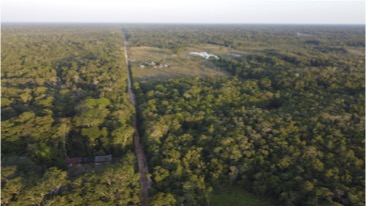
Photo:© Johannes Wilk, Global Land Monitoring group (GFZ)
“Small persistent humid forest clearings drive tropical forest biomass 3 losses”, Nature, janvier 2026. DOI 10.1038/s41586-025-09870-7