
Understanding the global Dole effect (DE) is essential for interpreting variations in the oxygen and water cycles. This study aims at refining the biological fractionation factors during respiration and photosynthesis in terrestrial plants and reassess their impact on the DE.
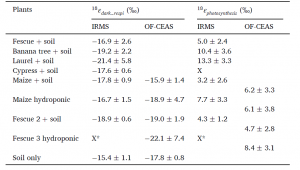
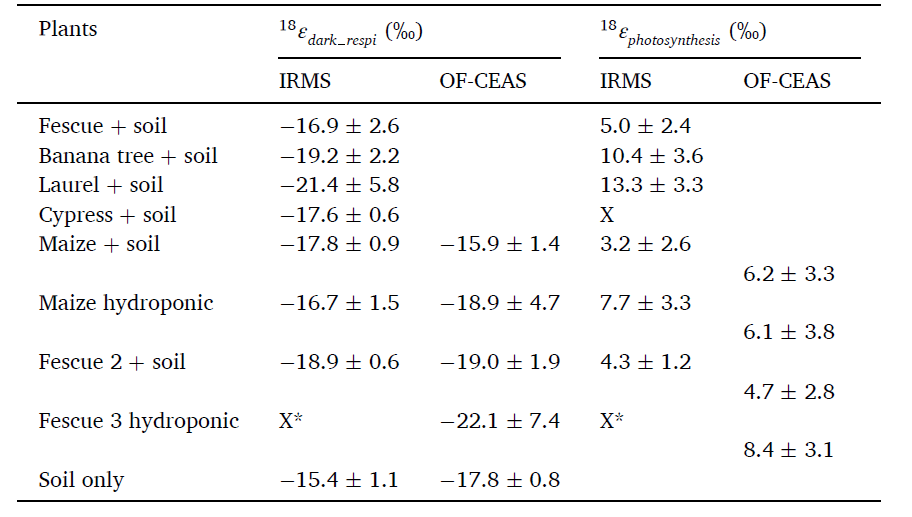
Using multiplexed closed chamber experiments on five C3 and C4 plant species under soil and hydroponic conditions, we quantified isotopic discrimination during respiration (-16 to -21 ‰) and photosynthesis (approximately +3 to +5 ‰). These results confirm a previously reported positive discrimination associated with terrestrial photosynthesis, challenging the assumption of zero fractionation in this process. By incorporating these new estimates into updated calculations obtained using outputs of Earth system models, we obtain variations in DE between the last glacial maximum and the pre-industrial period consistent with ice core data. However, the changes around 6000 years ago cannot be explained solely by variations in terrestrial and oceanic productivity ratios, reinforcing the role of low-latitude hydrological processes. These results highlight the need to improve quantification of biological fractionation associated with the oxygen cycle in reconstructions of past atmospheric composition.
Authors: Clémence Paul, Clément Piel, Joana Sauze, Ji-Woong Yang, Marie Bouchet, Olivier Jossoud, Arnaud Dapoigny, Daniele Romanini, Frédéric Prié, Sébastien Devidal, Roxanne Jacob, Alexandru Milcu, Amaëlle Landais
Quaternary Science Reviews 370 (2025) 109663, DOI: https://doi.org/10.1016/j.quascirev.2025.109663