

Extreme marine hazard events are expected to increase in the next future as a response to global warming. Estimating their frequency and magnitude in the recent past is of prime concern to better project their future impacts. In tropical reef provinces, coral boulders deposited on reef top surfaces can be used as key proxies for defining the occurrence – recurrence time and effects of paleo-storms.
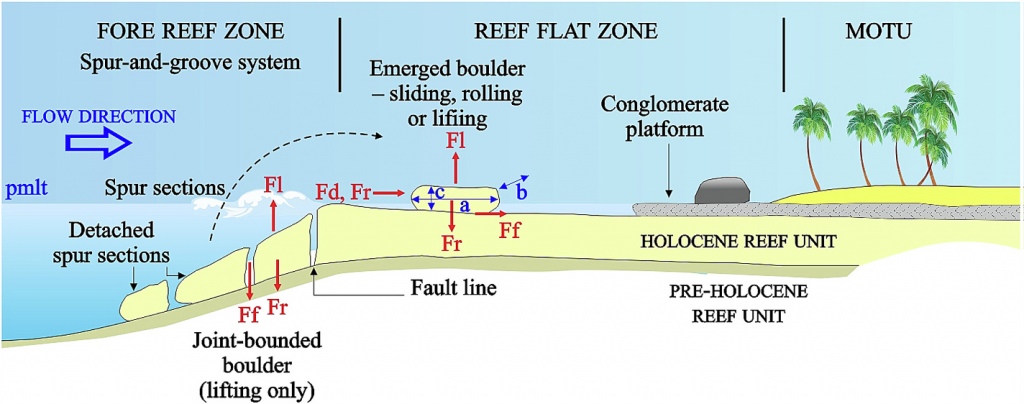
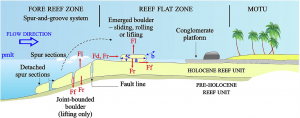
The present study defines origin, morphometry, location, orientation, timing and mode of deposition of a number of coral reef boulders present on reef-flats surfaces, along the south-eastern rim areas of Fakarava Atoll, north-west Tuamotu, central South Pacific. These boulders, extracted from the upper forereef spurs, were projected onto the reef-flat zone, at distances of 51 to 235 m from the outer reef edge. Among the 44 described boulders >20 m3, only 19 were revealed to be covered by well-preserved coral colonies in growth position and as such, were submitted to physical analysis and U/Th dating. Upper reef spurs have been built from about 5000 to 3000 cal. yr BP. Dominantly platy in shape, with sharp broken, lateral faces, the 19 investigated boulders range between 3 and 8.5 m long, 4 and 82 m3 in volume, 6.8 to 139.4 tons in weight.
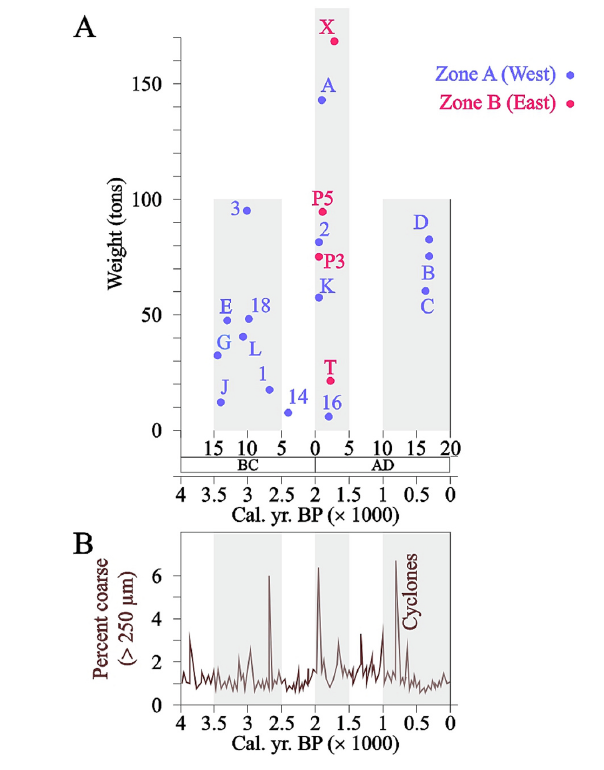
Figure 2: Relationship between the ages of deposition for the 19 U/Th dated coral reef boulders (SE reef rim margin, Kakarava Atoll, figure A) and ENSO-controlled cyclogenesis Iin the south tropical Pacific over the 3500 years (based on grain size analysis in a core from lagoonal sediments, Toomey et al., 2013; Bramante et al., 2020)
The minimum flow velocities to initially move and uplifted these blocks were estimated between about 4 to >13 m/s. Morphometric comparison of the boulder set investigated at Fakarava with those from nearby atolls recognized as cyclone-moved strongly suggests that boulder detachment and deposition at Fakarava have resulted from cyclogenesis than tsunamigenic impacts. Contrary to cyclone-related boulder deposition that appears to have occurred mainly during the last centuries in the nearby atolls, U/Th dating of boulders at Fakarava reveals that cyclogenesis has increased between 3400 and 2300 cal. yr BP (15th–4th centuries BC) and between 2,000 and 1,700 cal. yr BP (1st–4th centuries AD) in the considered region, with an expected mean reccurrence time of around 30 to 50 years. This intensification of cyclone activity is interpreted as related to amplified ENSO phases in the south Pacific.
Reference: Montaggioni L.F., Salvat B., Brunaud E., Pons-Branchu E., Poli G., Martin-Garin B. (2025). Coral reef boulders as recorders of cyclone activity over the last 3,500 years (Fakarava Atoll, Tuamotu, French Polynesia. Marine Geology, 107605.