

Defining the timing and accretional mode of low-lying, reef-rim islets over the recent past is a prerequisite for better understanding their future dynamical behaviour in response to rapid rise in sea level and increasing storminess. In high island settings where reliefs locally act as protection against meteorological hazards, establishing the level of vulnerability in the face of global warming remains an important issue.
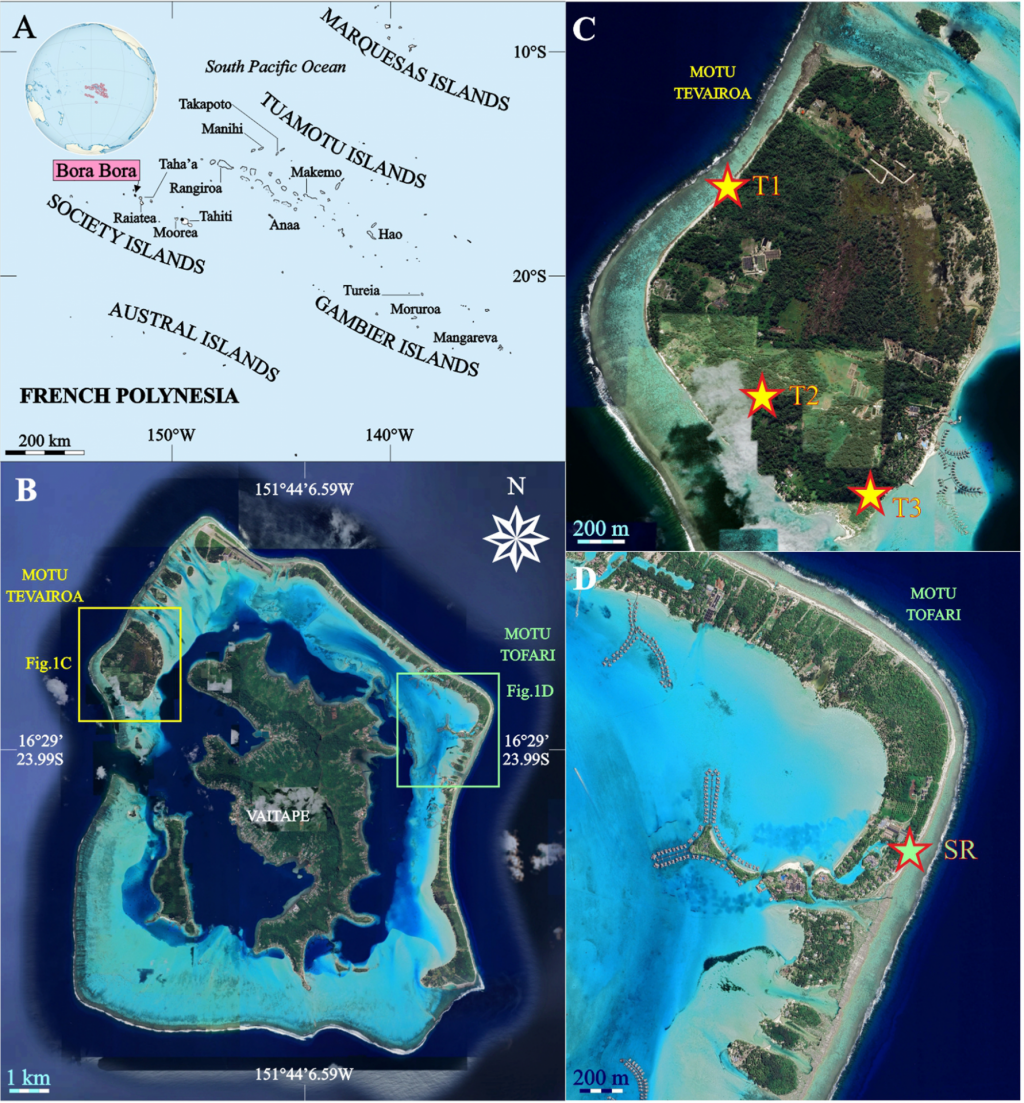
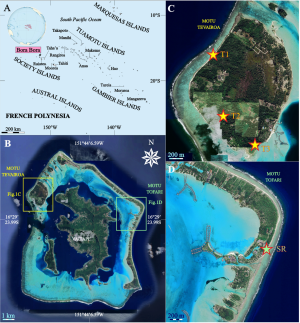
At Bora Bora, a high volcanic island (French Polynesia), internal lithostratigraphy of two selected islets – Motu Tevairoa, leeward, west-north-western side; Motu Tofari, windward, east-north-eastern side – from the barrier-reef rim was reconstructed from four excavated cross-sections. Motu Tevairoa exhibits at the ocean-facing shoreline, pebble-and sand-supported facies abruptly grading into sand-dominated facies inwards. Motu Tofari is dominated by boulder-pebble facies along the oceanic border. U/Th dating was conducted from a collection of 48 coral clasts, in order to reconstruct the timing of islet building. Motu Tevairoa appears to have started to develop by about 2300–2200 cal yr BP from a central islet depocentre laterally extending over time. At the ocean-facing settings, deposition was initiated by about 1600 cal yr BP. By contrast, on Motu Tofari, deposition along the oceanic shoreline, occurred as soon as 3100 cal yr BP. A time lag of approximately 1000 years seems to separate islet accretion between the windward and leeward sides.
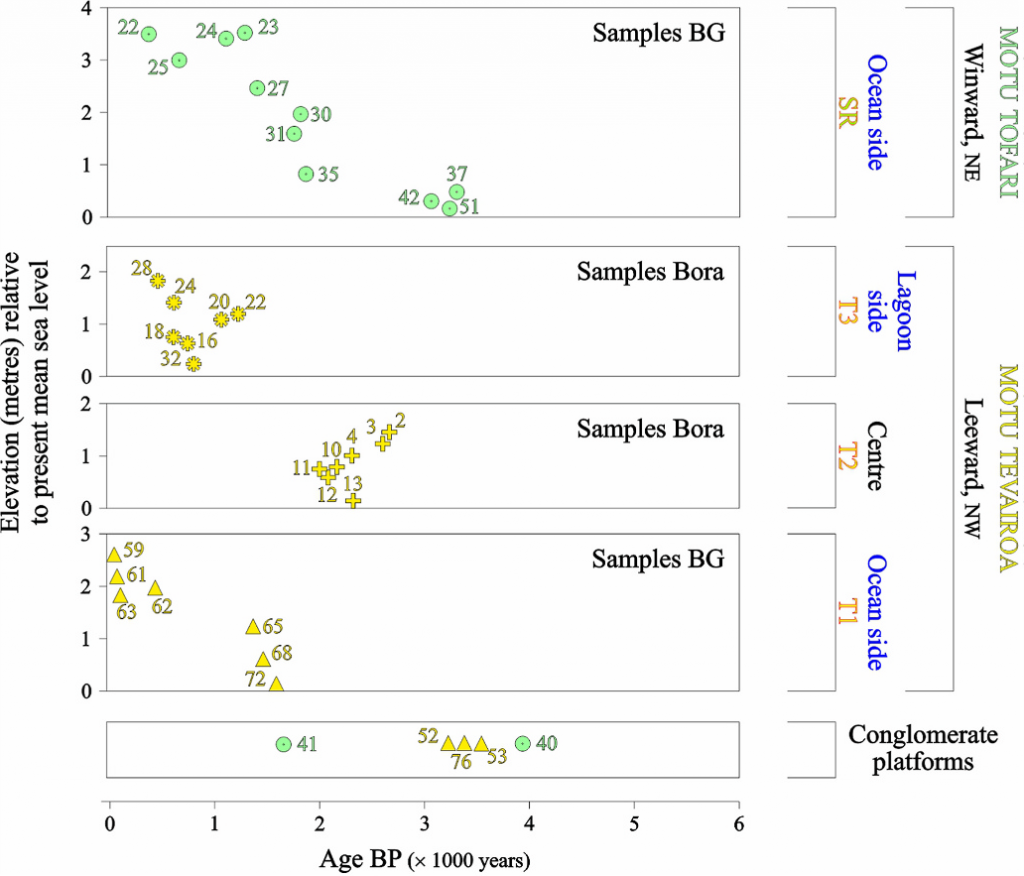
This strongly suggests that winter storms in the southern hemisphere and those generated from an easterly direction in the northern hemisphere, mid latitudes have played a major role in periodically supplying the north-eastern rim in coral detritus while the western side was occasionally nourished by distant-source swells derived from the north-western sectors. In both settings, the main phases of islet building occurred during the late Holocene sea-level drop. This questions the ability of islets at Bora Bora to adapt to a rapid rise in sea level in the near future.
Reference: Montaggioni L.F., Salvat B., Pons-Branchu E., Martin-Garin B., Poli G., Vénec-Peyré M.T. Lecchini D., Tong Sang G. (2025). Dephasing of islet building between leeward and windward reef-rim sides, Bora Bora Island, Society Archipelago, central South Pacific. Quaternary International 719, 109638