

Scleractinian coral skeletons serve as valuable environmental archives, offering key insights into past climate and ocean variability. Understanding the mechanisms underlying coral calcification is essential for reconstructing accurate paleoenvironmental records. However, calcification is a complex process regulated by both biological and environmental factors. This study explores the interplay between coral skeletal geochemistry and physiological processes, focusing on species-specific growth patterns, biomineralization dynamics, and the impact of diagenesis.
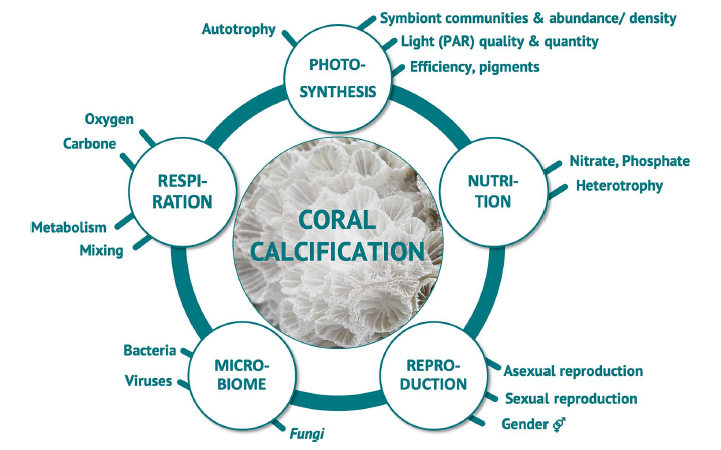
We highlight the use of elemental ratios (e.g., Mg/Ca, Sr/Ca, Li/Mg) as proxies for environmental reconstructions while addressing biases introduced by skeletal heterogeneity, bioerosion, and secondary mineral precipitation. Additionally, we discuss how physiological traits, such as symbiosis, nutrient uptake, and respiration, influence calcification and may affect the preservation of geochemical archives over time (Figure 1).
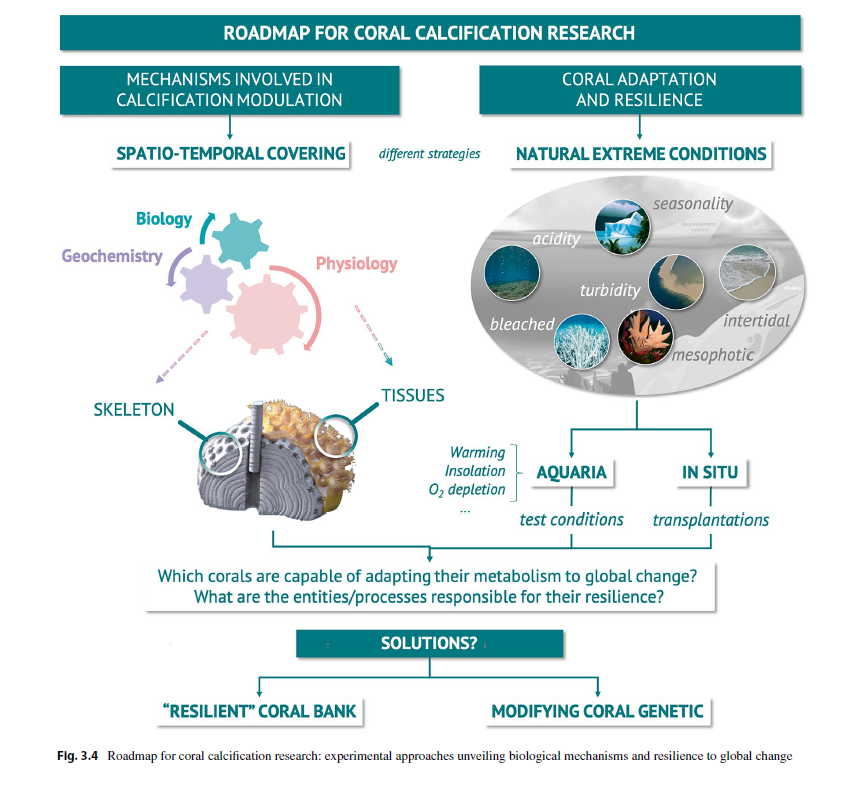
The integration of high-resolution geochemical analyses with biological insights is of great importance for refining paleoenvironmental proxies and enhancing the accuracy of climate reconstructions. This multidisciplinary approach provides a broader perspective on coral biomineralization, a critical issue for assessing reef resilience in a changing ocean.
Reference : Marine Canesi, E. Douville, C. Brahmi, L. Hédouin, S. Planes, P. Montagna, S. Reynaud. Scleractinian Coral Skeletons as Natural Archives of Global Change: A Cross-Disciplinary Investigation. In: Planes S. (eds) The Future of Coral Reefs. Coral Reefs of the World, 21. Springer, Doi: 10.1007/978-3-031-98584-3_3