

Precise synchronization of paleoclimate records is essential for inferring the dynamics and past evolution of the climate system. For the last glacial period, the time scales of ice cores from the Greenland and Antarctic ice sheets have been synchronized by the use of cosmogenic radionuclides, atmospheric gas concentrations, and traces of large volcanic eruptions.
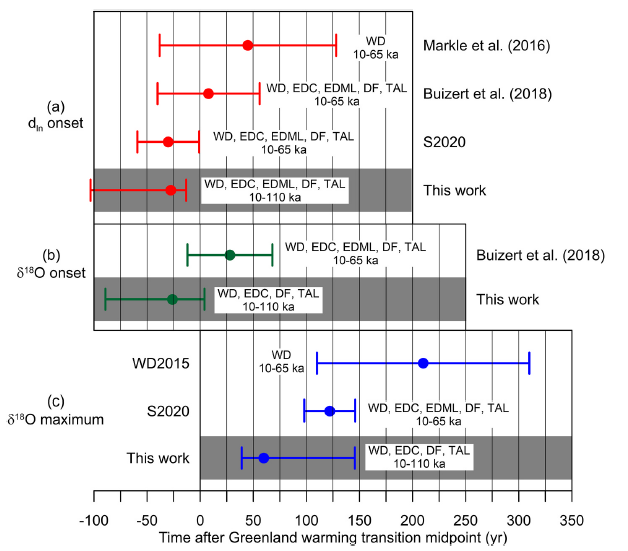
Here we identify the sulfate deposition signatures of the same 300 volcanic eruptions in different Greenland and Antarctic ice cores to obtain an inter-hemispheric volcanic ice-core synchronization of the entire last glacial period and the early Holocene (10–110 ka). Compared to earlier bipolar volcanic synchronizations, we close a gap in the period 16.5–24.5 ka and extend the synchronization to cover the 10–12 ka and 60–110 ka intervals. Furthermore, we increase the density of bipolar match points and make updates and corrections of the existing bipolar and unipolar synchronizations. The volcanic synchronization is in agreement with existing bipolar synchronizations from independent 10Be and methane matching. The bipolar volcanic synchronization allows us to determine the precise phasing of interhemispheric abrupt climate events throughout the last glacial period, particularly those associated with Dansgaard-Oeschger (D-O) events. Our improved synchronization and extended time period allow us to show that at the time of the D-O warming transitions, the average Antarctic temperature reaches a maximum within decades after the Greenland temperature maximum. This rapid Antarctic warming is superimposed on the well-known millennial-scale thermal bipolar-seesaw warming in Antarctica commonly attributed to oceanic heat transport and confirms earlier work that the abrupt change observed in Greenland is associated with a direct atmospheric circulation change at a global scale.
Authors: Anders Svensson, Guido Vettoretti, Jia-mei Lin, Giulia Sinnl,…., Amaëlle Landais, Marie Bouchet, Anna Klüssendorf, ….
Quaternary Science Reviews 375 (2026) 109755, DOI: https://doi.org/10.1016/j.quascirev.2025.109755