
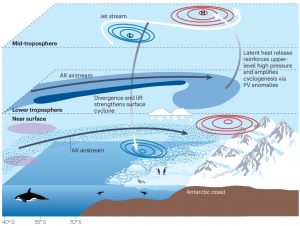
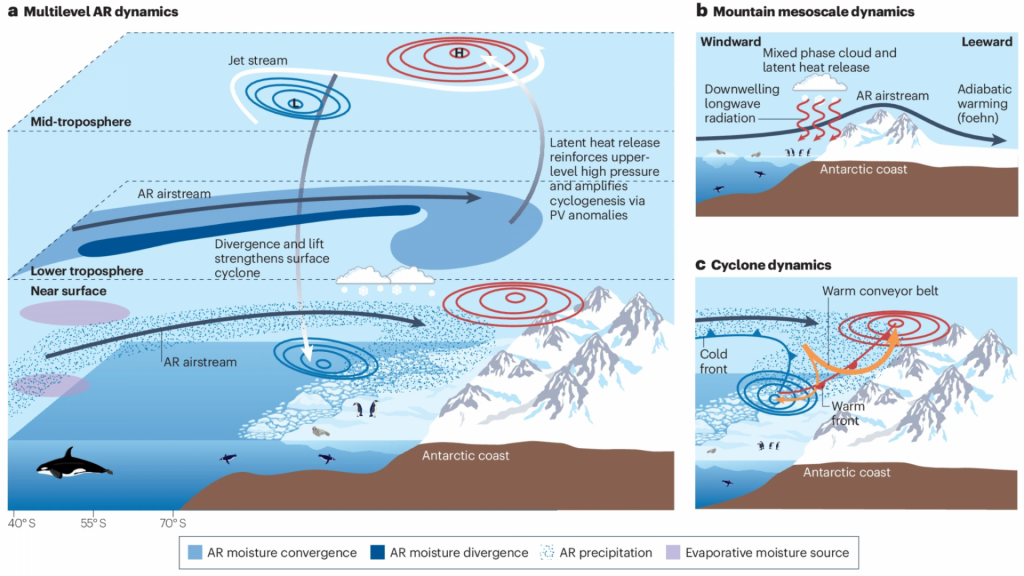
Antarctic atmospheric rivers (ARs) are a form of extreme weather that transport heat and moisture from the Southern Hemisphere subtropics and/or mid-latitudes to the Antarctic continent.
Present-day AR events generally have a positive influence on the Antarctic ice-sheet mass balance by producing heavy snowfall, yet they also cause melt of sea ice and coastal ice sheet areas, as well as ice shelf destabilization.
In this Review, we explore the atmospheric dynamics and impacts of Antarctic ARs over their life cycle to better understand their net contributions to ice-sheet mass balance. ARs occur in high-amplitude pressure couplets, and those strong enough to reach the Antarctic are often formed within Rossby waves initiated by tropical convection. Antarctic ARs are rare events (~3 days per year per location) but have been responsible for 50–70% of extreme snowfall events in East Antarctica since the 1980s.
However, they can also trigger extensive surface melting events, such as the final ice shelf collapse of Larsen A in 1995 and Larsen B in 2002. Climate change will likely cause stronger ARs as anthropogenic warming increases atmospheric water vapour. Future research must determine how these climate change impacts will alter the relationship among Antarctic ARs, net ice-sheet mass balance and future sea-level rise.
Authors: Wille, J.D., Favier, V., Gorodetskaya, I.V. et al., including Agosta C., Casado M. and Leroy-Dos Santos C.
Nature Reviews Earth & Environment, 6 (3), 178–192, https://doi.org/10.1038/s43017-024-00638-7, 2025.