
Il est difficile de quantifier les relations de phase entre les changements dans le forçage orbital Quantifying the phase relationships between changes in orbital forcing and internal climate responses, such as changes in atmospheric greenhouse gas concentrations and global sea level, during past glacial Terminations is challenging.
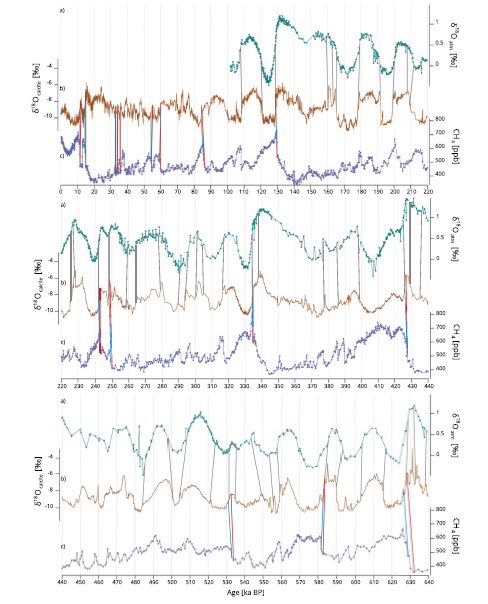
This is partly due to the lack of precise dating for climate archives beyond the range of radiocarbon dating. It is also challenging to build a coherent temporal framework that allows the sequence of events to be determined across multiple paleorecords from different types of archives. In this study, we present a methodology for establishing a coherent chronology covering the last 640 000 years, by integrating a selection of ice cores, sediment cores, and speleothems using the Bayesian dating model Paleochrono-1.1. Various sensitivity tests were conducted to explore the impact of climate alignment assumptions, the associated chronological uncertainties, and the assumptions related to the sedimentation scenario of the archives. These tests allow us to quantify uncertainty windows for the temporal offset between changes in atmospheric CO2 and in δ18Obenthic at the onset of six of the last seven glacial Terminations. With this approach, we provide uncertainties on this phasing from a minimum of 0.6 ka for Termination I, and up to 3.4 ka for Termination VI, compared with more than 4 ka of uncertainty previously.
Authors: Ellyn Auriol, Marie Bouchet, Emilie Capron, Frédéric Parrenin and Amaëlle Landais
Géosciences, Sciences de la Planète, Volume 357 (2025), p. 533-554, DOI : 10.5802/crgeos.318