
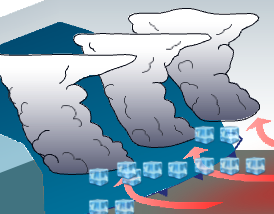
A recent attribution study shows that climate change amplified the intensity of the hailstorm that affected Paris and several regions of France and Germany on 3 May 2025. This work provides the first attribution analysis of a hail event in Europe.
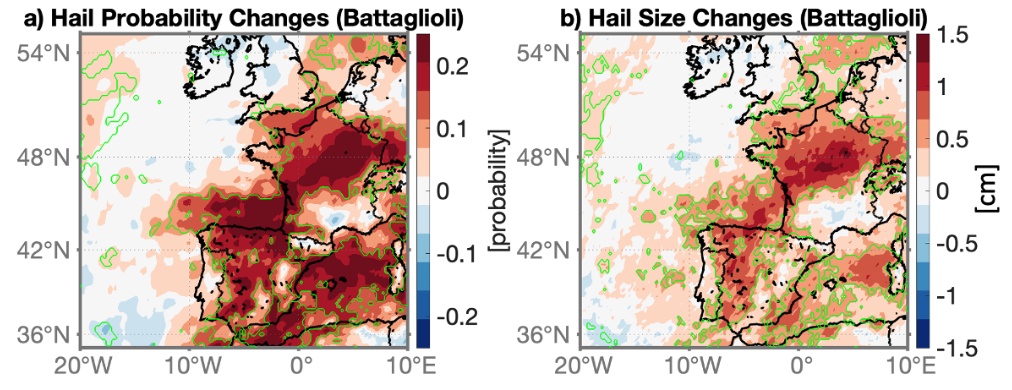
Figure: Climate-driven changes in hail probability and hail size under atmospheric conditions analogous to the 3 May 2025 event. (a) Change in hail probability. (b) Change in hail size (cm). Anomalies are computed between a past period (1974–1999) and a recent period (1999–2024) for comparable large-scale circulation patterns.
On 3 May 2025, a severe convective storm produced large hail across Paris and wide areas of France, with hailstones reaching several centimetres in diameter. The event caused major disruptions in urban areas and led to insured losses exceeding €300 million. To quantify the role of climate change, the study relies on an analogue-based approach, comparing the atmospheric conditions responsible for the event with similar large-scale circulation patterns observed in the past. By keeping the weather pattern fixed, the analysis isolates the impact of climate change through a comparison between two periods, 1974–1999 and 1999–2024. The results indicate that, under comparable meteorological conditions, hail probability has increased by up to 30 percent over Paris and several regions of France and Germany. At the same time, simulated hail sizes shift from marginally damaging values to clearly destructive ones, reaching 3 to 4 cm in many locations. In practice, events that were previously moderate now correspond to high-impact hazards.The study also shows that while the occurrence of hailstorms is largely controlled by natural climate variability, climate change significantly amplifies their intensity once triggered.
Based on Copernicus reanalysis data, which are better suited than climate models to represent convective processes, this work demonstrates that ongoing warming is already increasing hail risk across Europe. These findings are particularly relevant for densely urbanised areas such as Paris, where exposure and potential economic losses are expected to grow. Davide Faranda, CNRS researcher at LSCE/IPSL, notes that hail can no longer be considered a marginal or local hazard. In a warmer climate, such events become more intense and affect wider areas, including major cities. Tommaso Alberti, researcher at INGV, adds that the atmospheric circulation responsible for the event is not unusual in itself. However, when it occurs in a warmer and more unstable climate, it produces larger and more damaging hail, with cascading impacts on infrastructure, economic activity, and insurance systems.
Article Reference:
Faranda, D., and T.Alberti. 2026. “Investigating the Role of Climate Change in the 3 May 2025 Western Europe Hailstorm Using Atmospheric Analogs.” Atmospheric Science Letters27, no. 3: e70016. https://doi.org/10.1002/asl2.70016.