

Soils store more carbon than the atmosphere and vegetation combined, making them one of the most important regulators of the Earth’s climate. Yet which microbial processes most strongly control how much carbon remains stored in soils has long remained unclear. Answering this question is key to understanding how vulnerable soil carbon is to loss under climate change—and how such losses could further accelerate climate change.
A new international study lead by Xianjin He from the LSCE, published in Nature Ecology & Evolution, reshapes understanding of how soil microbes regulate the world’s largest carbon pool
Microbes pumping carbon
Soil microbes can be thought of as tiny carbon pumps operating underground which transfer labile carbon components into stable compounds – providing a critical service in driving carbon into soils. They feed on carbon released by plant roots and decaying organic matter, convert part of this carbon into new microbial biomass, and release the rest as CO₂ to the atmosphere. When microbes die, their remains — known as microbial necromass — can bind to soil minerals and become long-lived soil organic carbon.
In this study, the researchers focused on two key microbial properties:
- Microbial growth rate — how fast microbes build new biomass
- Carbon use efficiency (CUE) — how efficiently microbes convert carbon into biomass rather than respiring it as CO₂
Using 268 paired measurements worldwide, derived from the 18O–H₂O labeling method, the team compared these microbial traits with observed soil carbon stocks across diverse ecosystems. This method is currently one of the most reliable and widely used approaches for quantifying microbial growth rate and carbon use efficiency. It works like a molecular tracer: microbes consume water, and scientists can then track how much of that water ends up in newly formed microbial DNA — revealing how fast microbes grow and how efficiently they use carbon.
Growth rate outperforms efficiency
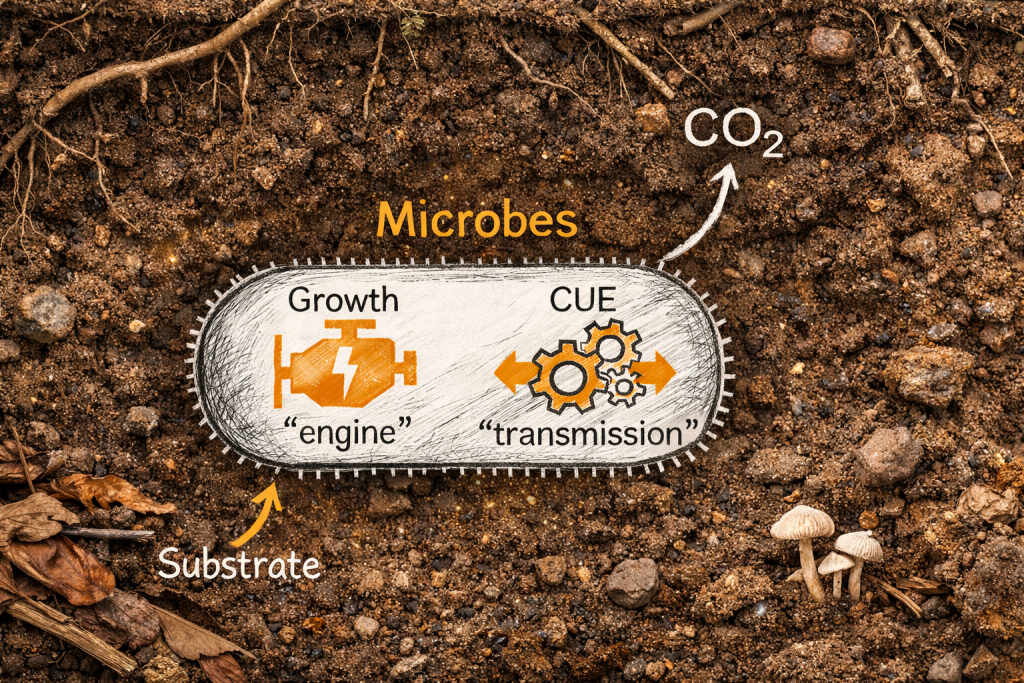
The results show that soils with higher microbial growth rates consistently contain more carbon. In contrast, CUE shows only a weak or negligible relationship with soil carbon storage. To illustrate this, the authors use a mechanical metaphor: microbial growth rate acts as the engine driving carbon fluxes through the soil, while CUE serves as the transmission, playing a secondary role by regulating how carbon is partitioned between biomass production and CO₂ release.
At the same time, climate and soil properties — especially temperature and clay content — explain as much or more variation in SOC than microbial properties. This highlights that soil carbon storage is jointly controlled by microbial activity and strong physical constraints.
Models overemphasize microbial efficiency
The team also analyzed four widely used global models used for climate change projections. While the models reproduce the stronger link between microbial growth rate and SOC, they tend to overemphasize the role of microbial properties and underestimate the importance of soil texture and climate.
Why it matters
Soils are central to climate mitigation strategies and long-term carbon storage. Accurately predicting how soil carbon will respond to climate change and land management requires models that capture the right biological and physical processes.This study identifies microbial growth rate as a key diagnostic variable for linking observations with Earth system models and for improving projections of soil carbon dynamics in a changing climate.
This work has been funded by the CALIPSO project.
Reference
Xianjin He, Gaëlle Marmasse, Junxi Hu, Rebecca M. Varney, Stefano Manzoni, Philippe Ciais, Ying-Ping Wang, Yongxing Cui, Edith Bai, Rose Abramoff, Elsa Abs, Erik Schwarz, Haicheng Zhang, Daniel S. Goll. Microbial growth rate is a stronger predictor of soil organic carbon than carbon use efficiency. Nature Ecology & Evolution. (https://www.nature.com/articles/s41559-025-02961-8)