
The ocean plays a major role in controlling atmospheric carbon, and benthic carbon represents the only geological-scale storage of ocean carbon. Despite its importance, observations of the ocean floor are limited and ocean models offer little long-term predictive capability, hindering our ability to understand the mechanisms involved. This article proposes a series of priorities to advance mechanistic understanding and better quantify the importance of benthos.
The ocean plays a major role in controlling atmospheric carbon on decadal and millennial scales, with benthic carbon representing the only geological-scale storage of ocean carbon. Despite its importance, detailed observations of the ocean floor are limited, and the representation of the benthic carbon cycle in ocean models is mainly empirical and offers little predictive power. This hinders our ability to properly understand the long-term evolution of the carbon cycle and the feedbacks related to climate change. At a workshop held in 2024 in the US, the Benthic Ecosystem and Carbon Synthesis (BECS) working group, with support from the US Ocean Carbon & Biogeochemistry Program (OCB), identified the main challenges that limit our understanding of benthic systems, opportunities to address these challenges, and ways to improve the representation of these systems in global modeling and observation efforts.
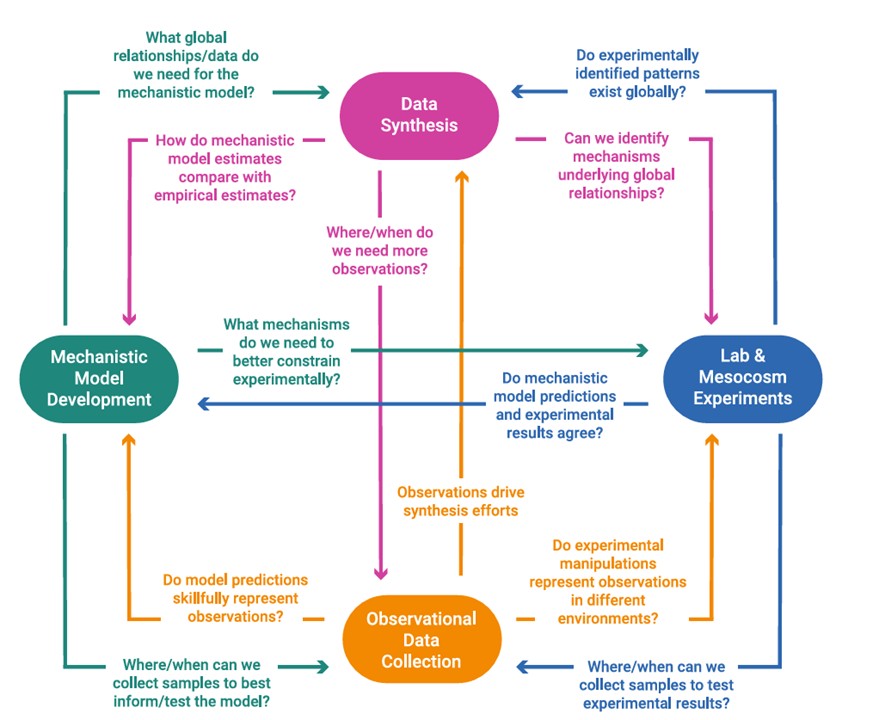
We have proposed a series of priorities to advance understanding of the mechanisms and better quantify the importance of benthos: (a) conduct a comparison exercise between existing benthic models to support future model development, (b) synthesize data to inform both model parameterization and future observations, (c) increase the deployment of platforms and technologies to support in situ benthic monitoring (e.g., from test benches to field mesocosms), and (d) coordinate a global benthic observation program (“GEOSed”) to fill significant regional data gaps and assess understanding of processes. Addressing these priorities will inform resource management solutions and climate adaptation strategies at the global and regional scales.