
The meltwater-driven disintegration of the Larsen B ice shelf has raised concerns that other ice shelves may face similar vulnerabilities as global temperatures rise.
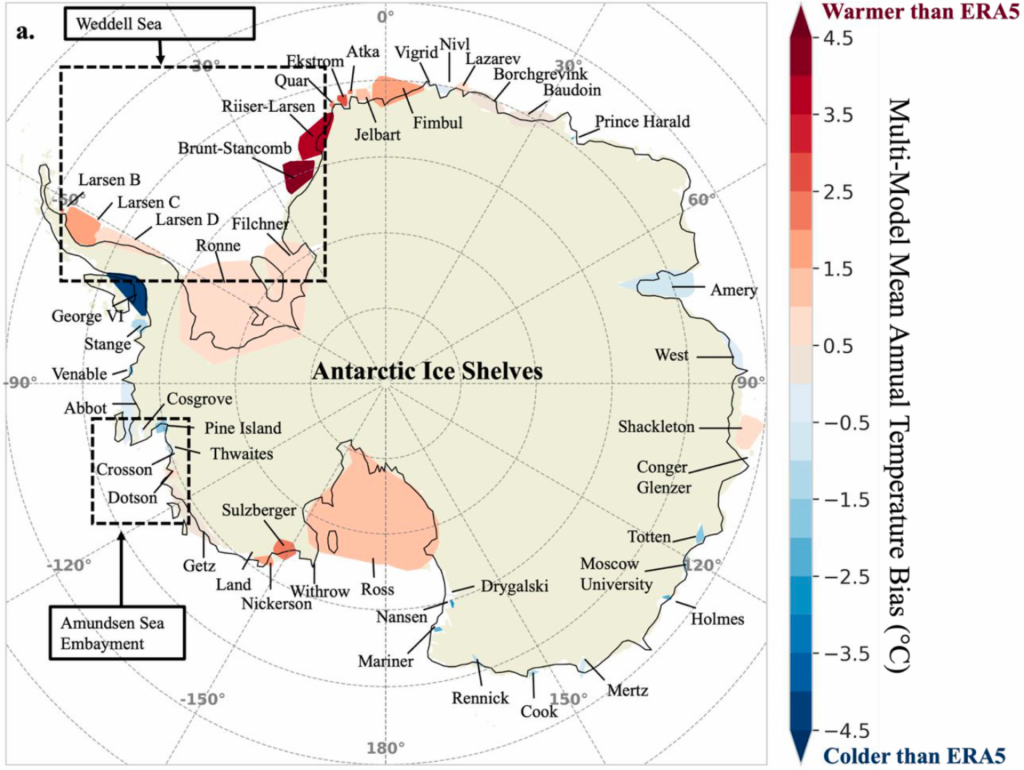
Climate projections show increased ice shelf vulnerability to surface melt in the coming century, yet the ability of large-scale climate models to simulate temperatures over ice shelves—a key factor in these projections—has rarely been assessed. We address this gap by using ERA5 reanalysis data to evaluate 31 CMIP6 models’ performance in simulating near-surface air temperatures over 46 Antarctic ice shelves from 1979 to 2014. We find that CMIP6 models exhibit annual and summer warm biases over most ice shelves. There is also inter-model variability of up to 13°C between model temperatures over the Amery and Riiser-Larsen shelves for both annual and summer periods.
Significant regional differences are present: shelves in the Amundsen Sea Embayment show cold biases, while those in the Weddell Sea show warm biases. While topography corrections can reduce some biases, we find notable seasonal differences, including biases with opposite signs between annual and summer means. Our results underscore the importance of careful model selection by shelf and region to improve the reliability of future climate projections and assessments of Antarctic ice shelf vulnerability.
Authors: Fields M, Bassis J, Kachuck S, Moldwin MB, and Agosta C.
Journal of Glaciology, published online, https://doi.org/10.1017/jog.2025.10121, 2026