
Antarctic near-surface winds play a key role in shaping the local climate of Antarctica.
For instance, they trigger drifting snow and reduce the amount of precipitation reaching the ground. Despite their importance, substantial uncertainties remain regarding their future changes over the continent associated with global warming, especially in winter. Here, we analyse projections of winter near-surface winds in Antarctica produced by four CMIP6 Global Climate Models downscaled by a regional atmospheric model adapted for the study of polar regions.
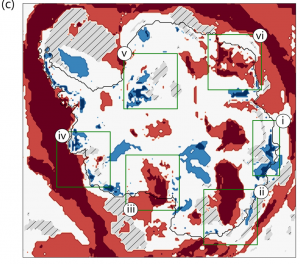
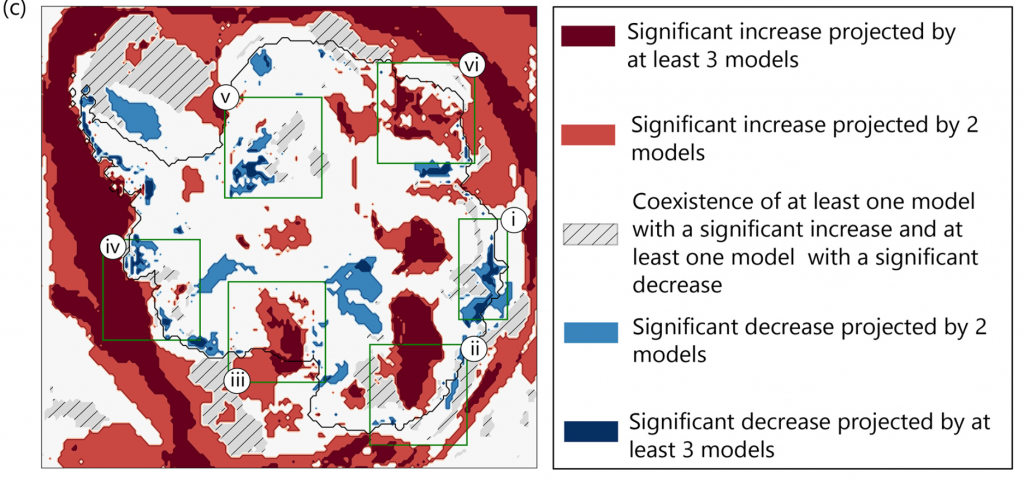
Our analysis first demonstrates that the downscaling helps to improve the representation of near-surface winds at present day. On the continent, projected changes in July wind speeds between the late 21st and 20th centuries reveal considerable regional variability, with opposing trends depending on the area and model used. Nevertheless, the 4 models used agree on a significant strengthening of near-surface winds in Adélie Land, Ross ice shelf and Enderby Land and a significant weakening in some coastal areas, such as the Shackleton ice shelf, the Amundsen embayment region and the Filchner ice shelf.
Using the momentum budget decomposition, we separate and quantify the contributions of different drivers to future changes in wind speed. These drivers include local forcings related to the net radiative cooling by the iced surface as well as large-scale forcing. We distinguish two types of local forcing: katabatic forcing (linked to the presence of a slope) and thermal wind forcing, which arises from horizontal gradients in the depth of the radiatively cooled surface layer. We project a significant decrease in both katabatic and thermal wind accelerations. Because in a warming climate they act to increase the wind speed in opposite directions, we find an overall compensation effect of the changes in katabatic and thermal wind at the margins of the continent, while large-scale forcing exhibits both significant increases and decreases depending on the location. Ultimately, we find that most significant strengthening of near-surface winds
Authors: Davrinche, C., Orsi, A., Amory, C., Kittel, C., and Agosta, C.
The Cryosphere, 19, 6023–6042, https://doi.org/10.5194/tc-19-6023-2025, 2025