
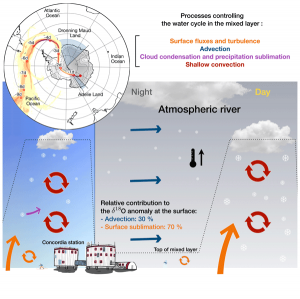
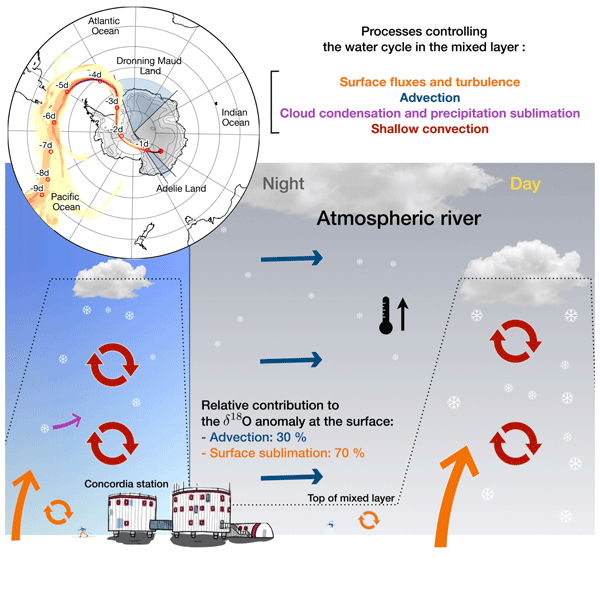
From 19 to 23 December 2018, an atmospheric river sourced in the Atlantic hit the French–Italian Concordia station, located at Dome C, East Antarctic Plateau, 3233 m above sea level (a.s.l.). It induced a significant surface warming (+18 °C in 3 d), combined with high specific humidity (3-fold increase in 3 d) and a strong isotopic anomaly in water vapour (+17 ‰ for δ18O). The isotopic composition of water vapour monitored during the event may be explained by the isotopic signature of long-range water transport, and by local moisture uptake during the event. In this study, we used continuous meteorological and isotopic water vapour observations, together with the atmospheric general circulation model LMDZ6iso, to describe this event and quantify the influence of each of these processes. The presence of mixed-phase clouds during the event induced a significant increase in downward long wave radiation, leading to high surface temperature and resulting in high turbulent mixing in the boundary layer. Although surface fluxes are underestimated in LMDZ6iso, near-surface temperature and specific humidity are well represented. The surface vapour δ18O is accurately simulated during the event, despite an overestimated amplitude in the diurnal cycle outside of the event. Using the LMDZ6iso simulation, we perform a surface water vapour mass budget by decomposing total specific humidity into contributions from individual processes. Our analysis demonstrates that surface sublimation, which becomes significantly stronger during the event compared to typical diurnal cycles, emerges as the dominant driver of the vapour δ18O signal at the peak of the event, accounting for approximately 70 % of the total contribution.
The second largest contribution comes from moisture input via large-scale advection associated with the atmospheric river, accounting for approximately 30 % of the total. Consequently, our results reveal that the isotopic signal monitored in water vapour during this atmospheric river event reflects both long-range moisture advection and interactions between the boundary layer and the snowpack. Only specific meteorological conditions driven by a pronounced moisture intrusion can explain these strong interactions. Given the marked imprint of air–snow exchanges on the vapour isotopic signal, improving the representation of local processes in climate models could substantially improve the simulation of the isotopic signal over Antarctica and provide valuable insight into moisture uptake processes.
Auteurs: Niels Dutrievoz, Cécile Agosta, Cécile Davrinche, Amaëlle Landais, Sebastien Nguyen, Étienne Vignon, Inès Ollivier, Christophe Leroy-Dos Santos, Elise Fourré, Mathieu Casado, Jonathan Wille, Vincent Favier, Bénédicte Minster, and Frédéric Prié
The Cryosphere, 20, 1025–1046, https://doi.org/10.5194/tc-20-1025-2026, 2026.