
Agricultural expansion in South America has led to profound environmental transformations, particularly in the Pampas, the vast expanses of natural grasslands and savannas, and the Atlantic Forest. Despite the extensive areas affected by these changes, the long-term effects of this expansion on sediment and pesticide transport in the region’s river systems remain poorly documented.
This study, published in the Journal of Hazardous Materials Advances, carried out by LSCE and EDYTEM in collaboration with their partners from South America (Federal University of Santa Maria, Federal University of Rio Grande do Sul, University of the Republic in Montevideo, Uruguay), France (BRGM) and Switzerland (University of Basel), made it possible to reconstruct the impact of these changes on soil degradation, within the framework of the international research project (IRP) CNRS CELESTE Lab and the Franco-Swiss ANR project AVATAR.
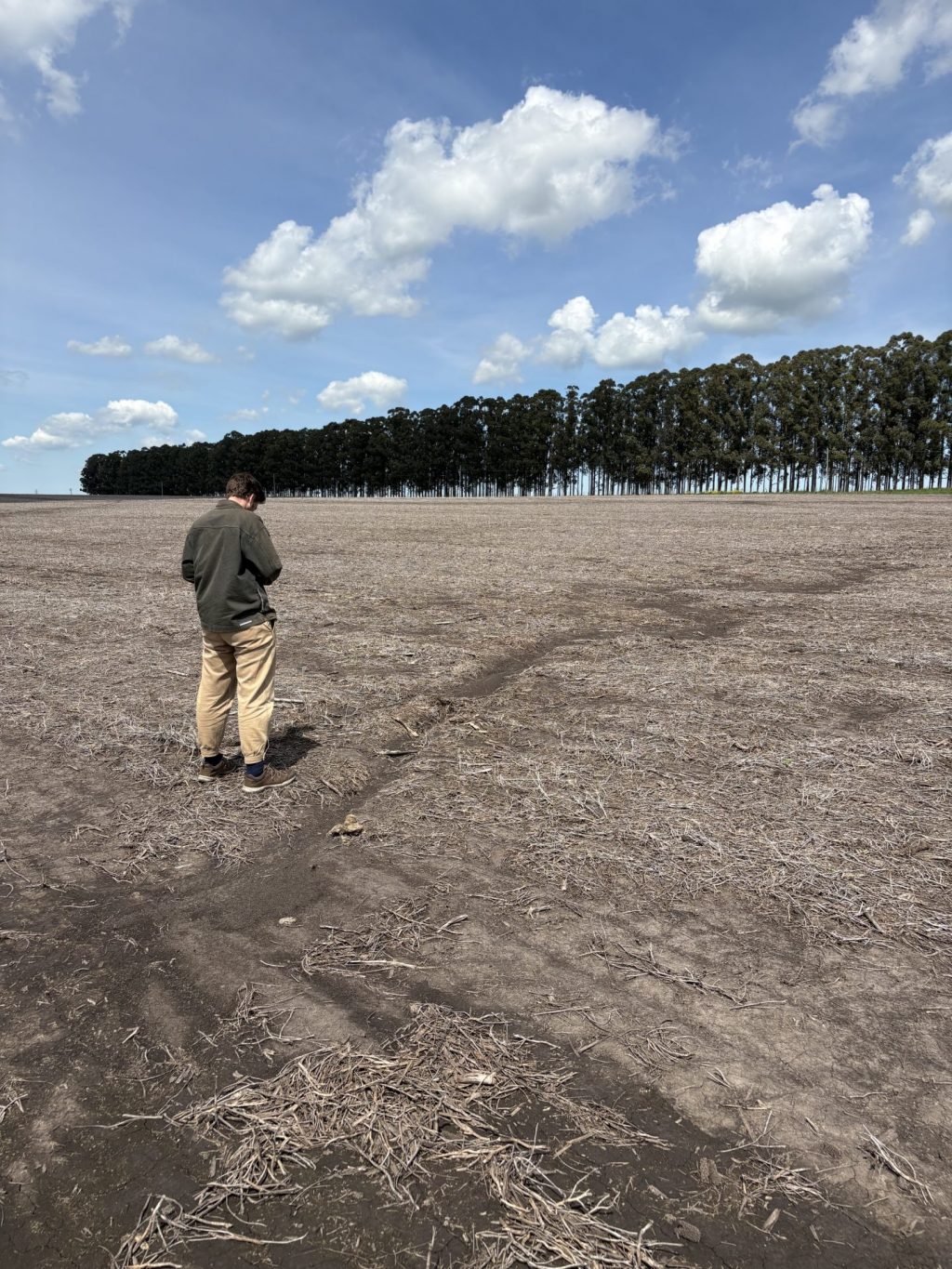
A sedimentary archive was collected from the Salto Grande dam reservoir, whose watershed drains one of Brazil’s most productive agricultural regions, the state of Rio Grande do Sul, which is the country’s first and second largest producer of rice and soybean, respectively. This region has also undergone significant changes in land use and agricultural practices, with a shift from conventional agriculture to conservation agriculture. Conservation agriculture relies on the widespread adoption of no-till farming, which involves planting crops with minimal soil disturbance while retaining crop residues to limit erosion. The collected sedimentary archive was analyzed using a multi-proxy approach combining radionuclide dating, high-resolution geochemical analysis, magnetic properties analysis, sediment provenance tracing, and pesticide quantification. The evolution of sediment and pesticide fluxes was thus reconstructed for the period between 1982 and 2023 in the vast transboundary Uruguay River basin (260,000 km²), shared between Brazil, Argentina, and Uruguay.
The results show that, since the 2000s, sediment fluxes have decreased overall by 62% downstream of this watershed. Alongside this decrease, a change in the dominant landscape sources contributing sediment to the reservoir was observed, with a sharp increase in the contribution of the southern part of the basin to reservoir deposition, rising from 40% between 1982 and 2000 to 70% of the fluxes between 2000 and 2023. These changes are consistent with the construction of dams, which have trapped sediments in the northern part of the basin, as well as with the expected impacts of the widespread adoption of no-till farming, which has reduced sediment fluxes. Furthermore, the observed shift in sediment source is consistent with the agricultural expansion that primarily affected the southern part of the basin during this period.
Contrary to the decrease in sediment inputs, pesticide fluxes have increased significantly in the recent period (2000–2023). Several compounds detected in surface sediments exhibit concentrations exceeding the reference thresholds at which a pesticide concentration is considered to pose a risk to communities exposed to these molecules. These results suggest a potential ecological risk to benthic communities, the groups of species living at the interface between water and sediment. These findings demonstrate that no-till farming, implemented on a large scale in southern Brazil over the past two decades, has reduced sediment transfers to the main reservoir. However, it has led to an increase in pesticide transfers downstream, particularly due to their use against weeds in no-till systems and the use of genetically modified herbicide-resistant seeds. The implementation of additional measures remains essential to further reduce these sediment and pollutant transfers.
In this context, trade agreements such as those concluded between the European Union and Mercosur, and the associated increase in land area dedicated to soybean cultivation, could encourage continued agricultural expansion and an intensification of the associated environmental pressures. This study thus underscores the need to strengthen the monitoring of agricultural land use, contaminant transfers, and their effects on the aquatic ecosystems of the Uruguay River basin.