

Haut-Labourdette, M., Ledru, M.-P., Govin, A., Hatté, C., & Boëda, E. (2025). Understanding the presence of early humans in northeastern Brazil: Synthesis of paleoenvironmental reconstructions. Palaeogeography, Palaeoclimatology, Palaeoecology, 680, 113367. https://doi.org/10.1016/j.palaeo.2025.113367
In the context of the peopling of the Americas, initial human entry was long believed to have occurred solely around 15 kyr B⋅P., during the exposure of the Bering Land Bridge and the existence of an ice-free corridor in North America However, a growing number of archeological sites dated between 13 and 40 kyr emerged across the America, prompting multiple migration models regarding the timing and method of arrival of the early peopling of the Americas.
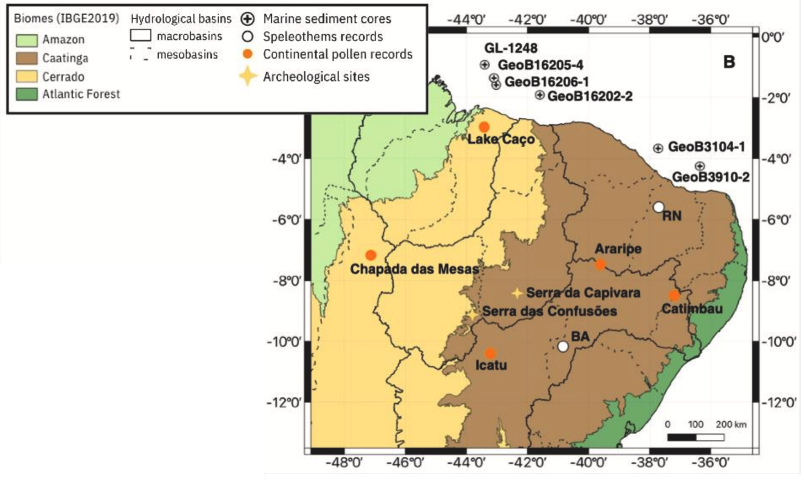
Northeastern Brazil (NEB, Fig. 1), one of the earliest human settlements in South America, is mainly covered by the semi-arid deciduous forest Caatinga and the semi-deciduous forest Cerrado. Despite extensive archaeological data advocating human presence in the Serra da Capivara throughout the last 40 kyr, archeological investigations lack integration of paleoenvironmental reconstructions, limiting a comprehensive understanding of human occupation. Open vegetation seemed to dominate during the last glacial period, interrupted by millennial-scale increases of mesophyllous taxa linked to enhanced precipitation.
Here we synthesized 18 paleoclimatic and paleoenvironmental publications, based on pollen, charcoal, isotopic and geochemical proxies from 6 marine and 8 continental archives, covering the end of the last glacial period and the Holocene to better understand early human resilience throughout the last 40 kyr. Ethnobotanical, archeobotanical and zooarcheological studies were also integrated to assess the nature and availability of NEB natural resources under varying climatic conditions.
Intermittent occupation at the sites’s scale and continuous occupation at the scale of the Serra da Capivara throughout the Late Pleistocene climatic and environmental variations suggest that human occupation was not restricted to intervals of increased humidity.
Pollen and anthracological records document the occurrence of native food plants (e.g. Byrsonima, Hymenaea and Mauritia) yet, it remains difficult to quantitatively assess their availability through time. Megafauna assemblages advocate for diversified environments and resources availability until the end of the Pleistocene. We discuss the contribution of these finding to broader global discussions regarding human resilience in semi-arid environments.