

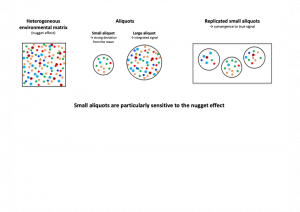
Advances in analytical techniques now allow isotope and geochemical measurements on ever smaller samples, opening new fields of application in environmental studies. Yet, in heterogeneous solid matrices commonly encountered in environmental systems (e.g. soils, sediments, particulate materials in water and air), this approach raises a critical issue: do tiny aliquots still represent the original sample, or do they provide a partial and potentially misleading signal? To address this question, we combine statistical simulations with empirical data. Using a soil simulated 14C distribution and 14C measurements on an Argentinian Acrisol, we show that single measurements on small aliquots (~100 μg C) often fail to reproduce the mean signal of the parent sample.
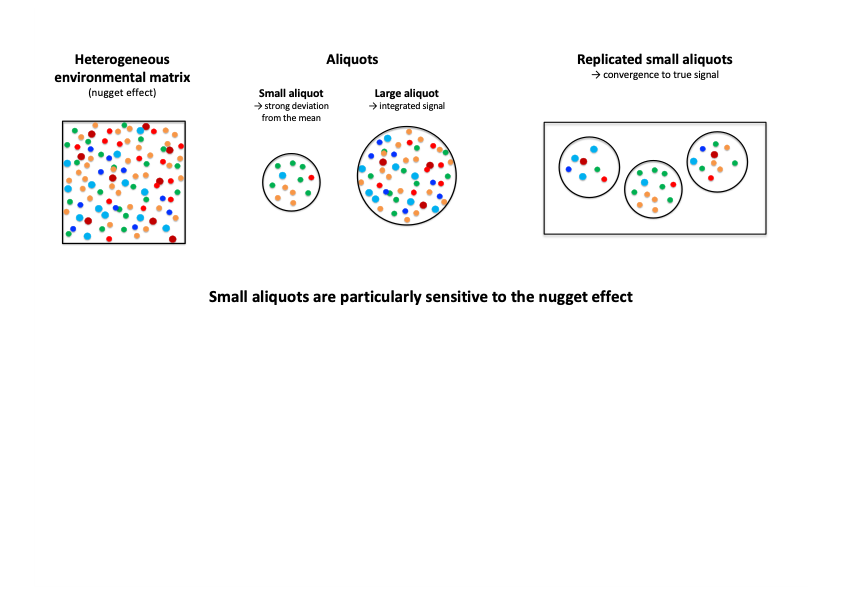
Replication improves representativeness, but the number of replicates required depends on the degree of heterogeneity and must be determined case by case. Similar patterns are observed for δ13C, where variability between replicates exceeds analytical error. Although our examples focus on 14C and δ13C, the underlying reasoning applies broadly to isotope-based approaches used to interpret environmental processes, including biogeochemical cycling, environmental monitoring, and assessments of environmental change. In the context of environmental microsampling, analytical precision is no longer the main limitation; ensuring representativeness through an appropriate replication strategy has become essential for robust environmental interpretation.
Reference: Hatté C., Ejaz M., Gauthier C., Jedrzejowski M., Moretti L., Morrás H., Nadeau M.-J., Pawełczyk S., Piotrowska N., Thil F., Tifafi M., Tisnérat-Laborde N., Ustrzycka A. (2026). Aliquot size and sample heterogeneity in environmental studies: consequences for isotope-based interpretation. Science of the Total Environment, 1029, 181712, doi : 10.1016/j.scitotenv.2026.181712