

Présentation
The BIPRISM project aims to quantify global biosphere productivity during the Last Glacial Maximum (LGM) by addressing critical uncertainties in the interpretation of Δ17O of O2—a proxy for past productivity—trapped in polar ice cores. This is essential for understanding the biosphere’s role in past CO₂ variations and improving climate projections.
LEFE
Coordinateur : YANG Ji Woong
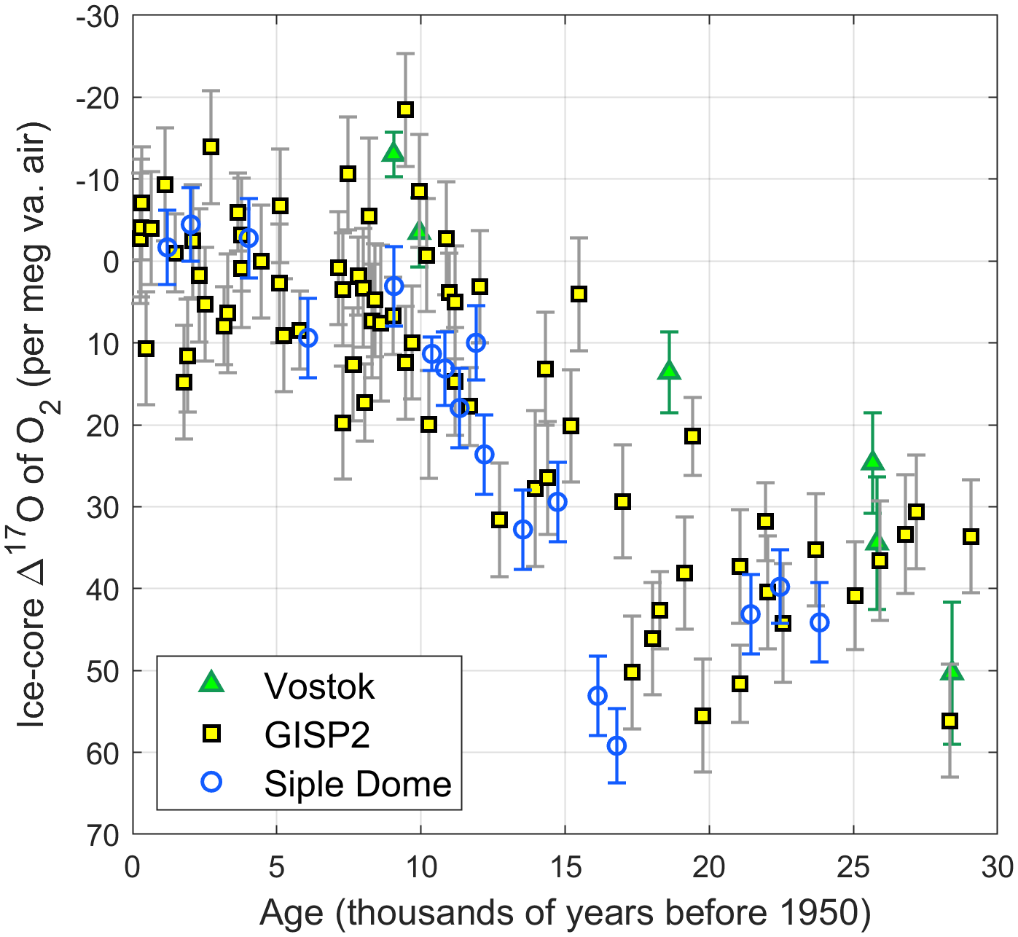
Current estimates of LGM productivity (78 ± 4% of modern levels) rely on unvalidated assumptions about stratospheric processes and suffer from analytical imprecision (10 per meg uncertainty) and site-specific biases in ice-core data. Two major gaps exist: (1) poor constraints on stratospheric isotope fractionation and stratosphere-troposphere exchange (STE), and (2) unresolved isotopic effects during pore close-off in firn.
The project combines numerical modeling (box and climate-chemistry models) to simulate stratospheric processes and laboratory improvements (automated gas extraction, temperature control) to enhance Δ17O of O2 measurement precision. Fieldwork will analyze firn-ice transition zones at contrasting Antarctic sites (e.g., D47, LDC) to correct for close-off fractionation.
By revising stratospheric assumptions, reducing analytical uncertainty, and quantifying close-off effects, BIPRISM will deliver a revised estimate of LGM biosphere productivity and assess its sensitivity to past climate conditions.