

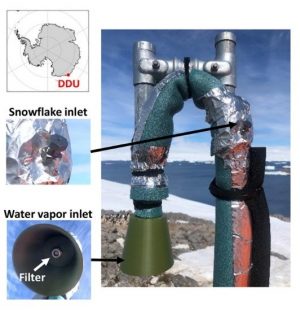
Water isotopes in precipitation are a powerful tool to better understand the processes governing snowfall in Antarctica, which is essential to improve our knowledge of the Antarctic atmospheric water cycle and surface mass balance, and for the interpretation of past climate signals archived in ice cores. However, precipitation isotope observations in Antarctica rely on manual sampling, which is prone to fractionation under low accumulation rates and remains both time-consuming and logistically demanding, and thus restricted to stations and seasons where manual sampling is feasible.
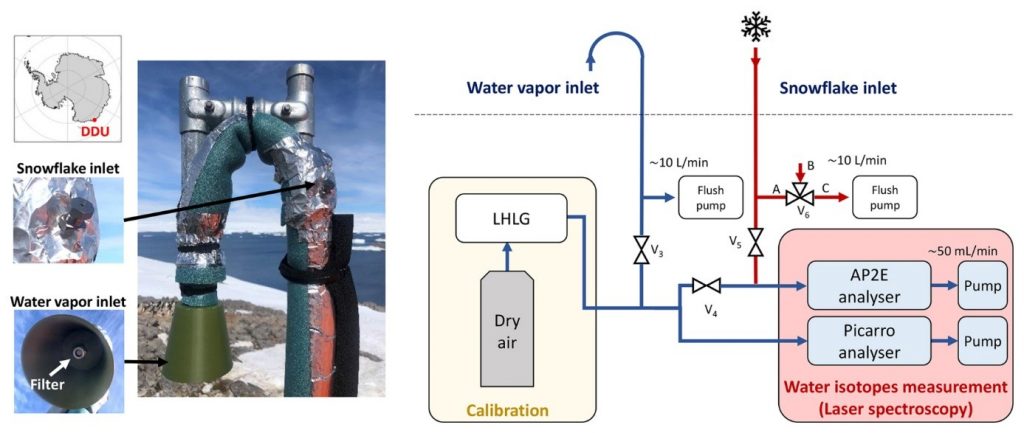
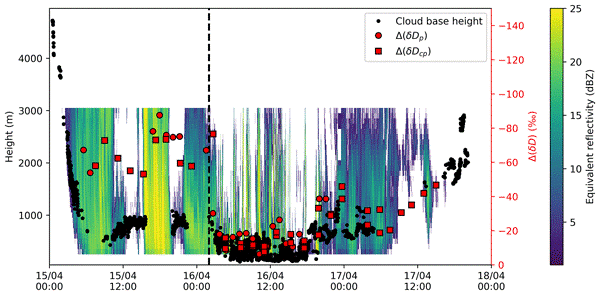
In this study, we present a novel method that enables autonomous, continuous, and combined measurements of water vapor and precipitation δD, using a single laser spectrometer. This technique offers new observational capabilities to better capture the isotopic signature of snowfall events in polar environments. Compared to conventional manual sampling of precipitation, the technique is capable of analysing very small amounts of condensed water, while avoiding post-depositional effects. In addition, it enables high-temporal-resolution observations and is well suited for long-term deployments in unmanned environments. The sampling system prototype has been deployed at Dumont d’Urville station, located on the coastal margin of East Antarctica, and evaluated during three precipitation events from February to June 2023. A dedicated post-processing algorithm was developed to retrieve the isotopic composition of precipitation from the surrounding vapor background. Comparisons with independently collected snow samples show a mean deviation of -5.4 ‰ in δD, which is well below the observed intra-event signal amplitude of about 100 ‰. This demonstrates the reliability of both the sampling system and the retrieval algorithm to study the isotopic composition of precipitation at the event-scale. With this new dataset, two applications are proposed to better understand the water vapor – precipitation relationship at Dumont d’Urville: (1) an evaluation of the LMDZ6iso general circulation model, and (2) a comparison with ground-based remote sensing instruments (ceilometer and micro rain radar) to explore the potential of the Δ(δD) metric as a proxy for snow formation altitude. Beyond polar applications, the proposed method opens new possibilities for other types of observations, including liquid precipitation sampling or cloud water isotopes monitoring onboard aircraft.
Authors: Thomas Lauwers, Elise Fourré, Niels Dutrievoz, Cécile Agosta, Olivier Jossoud, Bénédicte Minster, Frédéric Prié, Olivier Cattani, Valérie Masson-Delmotte, Mathieu Casado, Christophe Genthon, and Amaëlle Landais
EGUsphere, https://doi.org/10.5194/egusphere-2026-256, 2026