

Paris, France – 13 Avril 2026
A breakthrough in paleoclimatology, published today in Nature Geoscience, finally resolves a decades-old puzzle: why the relationship between water isotopes in Antarctic ice cores and temperature varies so dramatically across space and time. Led by Dr Mathieu Casado of the Laboratoire des Sciences du Climat et de l’Environnement (LSCE, CNRS CEA UVSQ UPSaclay), an international team of researchers has developed a groundbreaking framework that explains these discrepancies.
The 70-Year-Old Problem
Since the pioneering work of Willi Dansgaard and Claude Lorius in the 1950s, scientists have used the isotopic composition of water in ice cores (specifically, the ratio of heavy to light isotopes) as a “paleothermometer” to reconstruct past temperatures. However, this method has faced a persistent challenge: the relationship between isotopes and temperature is not consistent across space or time. Measurements from distinct locations often show a much stronger isotope-temperature relationship than measurements from the same place taken at different times. This inconsistency has made it difficult to reliably interpret ice core records and reconstruct past climates with confidence.
The Breakthrough
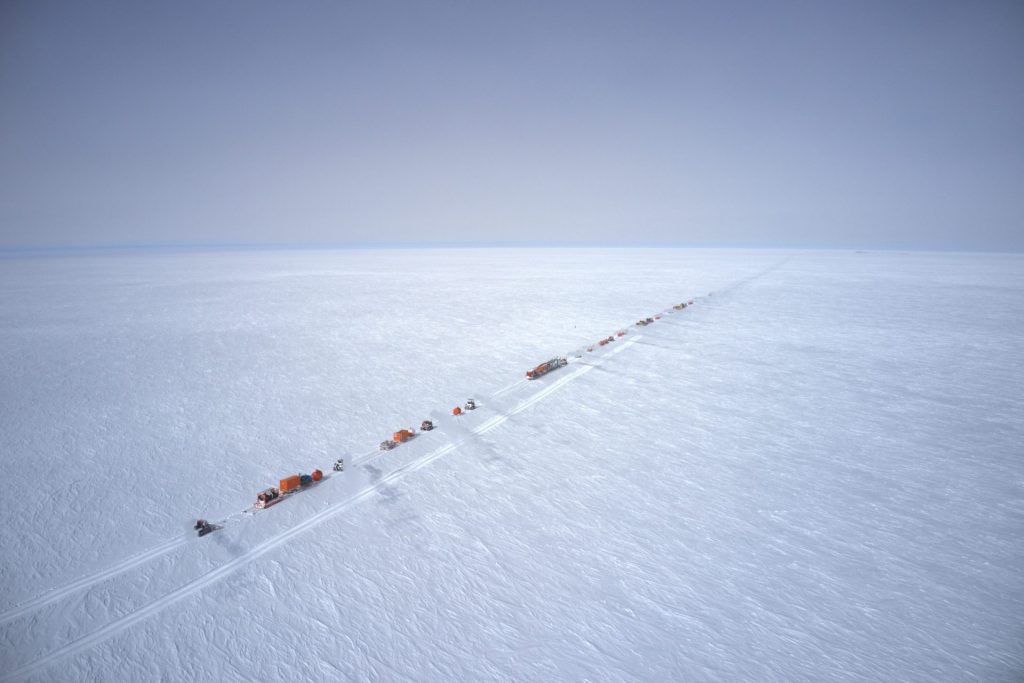
Complicating the situation, spatial and temporal slopes are derived using very different observational methods. The spatial relationship is typically calculated from samples of firn (or ice), which may represent long chunks of time each, say more than 10 years. In contrast, temporal relationships are typically derived using individual daily snowfall data. This leads to uncertainty in determining whether the difference between spatial and temporal relationships is due to the sampling inconsistencies or is an inherent property of the hydroclimate system. Using cutting-edge infrared spectroscopy, the team measured water vapour isotopes in real time during a 3,500 km traverse across East Antarctica. By combining these new measurements with data from fixed stations of vapour, precipitation, and surface isotopic composition, and climate model simulations, they were able to uncover the physical mechanisms underlying the differences in isotope-temperature relationships.
The study reveals that the differences between spatial and temporal isotope-temperature relationships are driven by large-scale atmospheric circulation and moisture transport. As air masses move from the coast to the interior of Antarctica, moisture undergoes distillation, which alters its isotopic composition. This process is more pronounced over space than over time. The team developed a conceptual framework that considers characteristic the pathways along which moisture moves from lower latitudes toward the poles. It is these different pathways. It is because different pathways intersect different elevations on the Antarctic plateau that the spatial isotope-temperature relationship differs from the temporal isotope-temperature relationship.
“Higher elevations on the Antarctic plateau are connected to more distant moisture source regions,” said University of Michigan assistant professor and study co-author Adriana Bailey. It is because the moisture at higher elevations experiences a longer ‘water-cycle journey’, that we see a stronger sensitivity between the isotope ratio and temperature. Higher sensitivities in elevated regions versus lower sensitivities in coastal regions influences the isotope-temperature relationship in space.”
Why It Matters
This research represents a major advance in paleoclimatology. By resolving the long-standing inconsistency in the isotopic paleothermometer, scientists can now more accurately reconstruct past temperatures from ice cores. This is crucial for understanding Earth’s climate history, including past glacial and interglacial periods, and for improving predictions of future climate change.
CNRS research and lead author of the study, Dr Casado emphasises the significance of this work: “For 70 years, we’ve known that the isotopic paleothermometer was inconsistent, but we didn’t fully understand why. With this study, we’ve finally fixed the thermometer. Our framework allows us to interpret ice core records with greater confidence, opening new doors for understanding Antarctica’s role in global climate change.”
A Global Collaboration
The study was conducted as part of the East Antarctic International Ice Sheet Traverse (EAIIST), a collaborative effort involving researchers from France, Italy, Australia, the USA, Japan, Germany, Belgium, and Ireland. The project was supported by the French National Research Agency (ANR), the BNP Paribas Foundation, the European Research Council, and the French Polar Institute (IPEV).
For more information, check the study here https://www.nature.com/articles/s41561-026-01961-y or contact: Dr Mathieu Casado Laboratoire des Sciences du Climat et de l’Environnement (LSCE)