

During the last glacial period, the Laurentide ice sheet experienced massive discharges known as Heinrich events. The mechanisms driving these events remain an open question. Current hypotheses include internal ice sheet instabilities and external triggers to the ice sheets, such as variations in ocean temperature (and sub-shelf melt rates). In all cases, ice sheet mass loss leads to freshwater input into the ocean and a rise in sea level. These surface ocean changes may reduce dense water formation and weaken the Atlantic Meridional Overturning Circulation. A key tracer of such oceanic changes is the δ13C isotopic ratio recorded by the epifaunal benthic genus Cibicides (Cib.). The Cib. δ13C has been shown to record the δ13C of dissolved inorganic carbon (δ13C-DIC) in bottom waters and is used to trace water masses and as a proxy of bottom water ventilation.
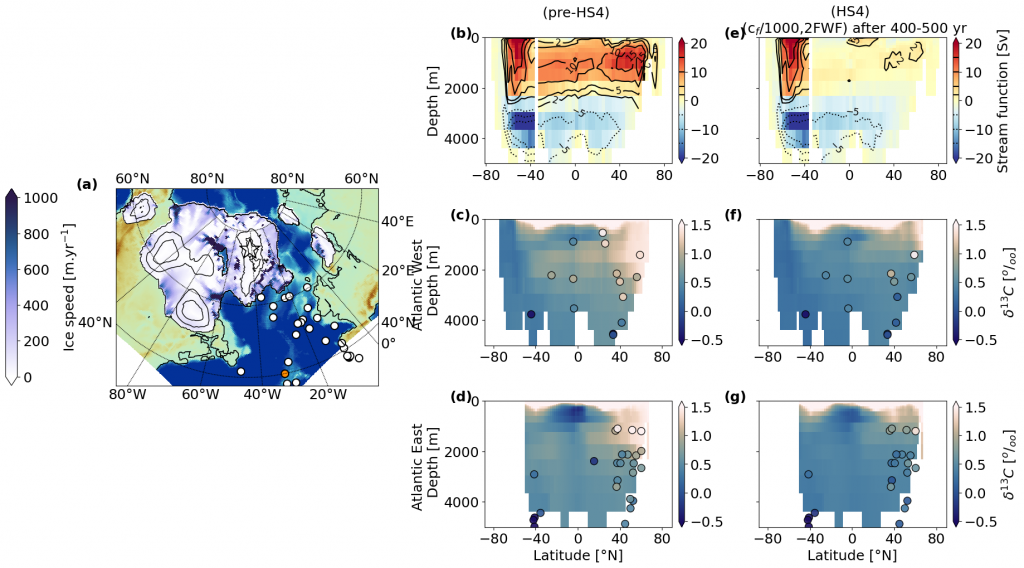
(a) Ice speed (m.yr-1) at the end of the spin‐up (equilibrium simulation at 40 kyr BP). Contours are 0, 2,000, and 3,000 m ice thickness contour. White dots are the locations of some cores used in this study. (b) Atlantic meridional overturning stream function (Sv) between 40 and 90°N and global overturning south of –40°N over the last hundred years of the spin‐up. δ13C (‰) values in the (c) Atlantic West and (d) Atlantic East basins, over the last 100 yrs of the spin‐up. Background colors are the model, and dots are the data averaged between 41.4 and 40.9 kyr BP. Panels (e, f, g) show the same information as panels (b, c, d), but for a perturbation simulation, 400 to 500 years after the onset of the perturbation. In this simulation, which yields the best agreement between model and data, basal friction beneath the Hudson Strait is reduced by a factor of 1000, and freshwater fluxes to the ocean are amplified by a factor of 2. The data (dots) in panels (f, g) correspond to the period from 39.3 to 38.8 ka BP.
In this study, we investigate the sensitivity of ocean circulation and δ13C-DIC to ice discharge events from the Laurentide ice sheet. To do so, we use an isotope-enabled coupled climate–ice sheet model in combination with observational data. Ice discharges are triggered either by reduced basal friction at the ice sheet–bedrock interface or by increased sub-shelf melt rates in the Hudson Strait ice stream region.
In both scenarios, simulated δ13C decreases following freshwater release and the associated weakening of deep water formation. The best agreement with the observed δ13C anomalies is achieved with large ice volume loss, by reducing ice sheet basal friction. In our model, the freshwater discharges from the Laurentide ice sheet need to be amplified to better represent the observed δ13C changes. The Laurentide ice sheet alone does not seem able to explain the observed oceanic δ13C variations, which may indicate that additional processes are required to account for these changes.
Authors: Louise Abot, Claire Waelbroeck, Aurélien Quiquet, Nathaelle Bouttes
Article: https://agupubs.onlinelibrary.wiley.com/doi/10.1029/2025GL118490