

A new publication involving LSCE researchers presents RHITA, an open tool designed to detect, track and characterize extreme weather events across Europe in near real time. The tool also places current events in the context of the past 75 years.
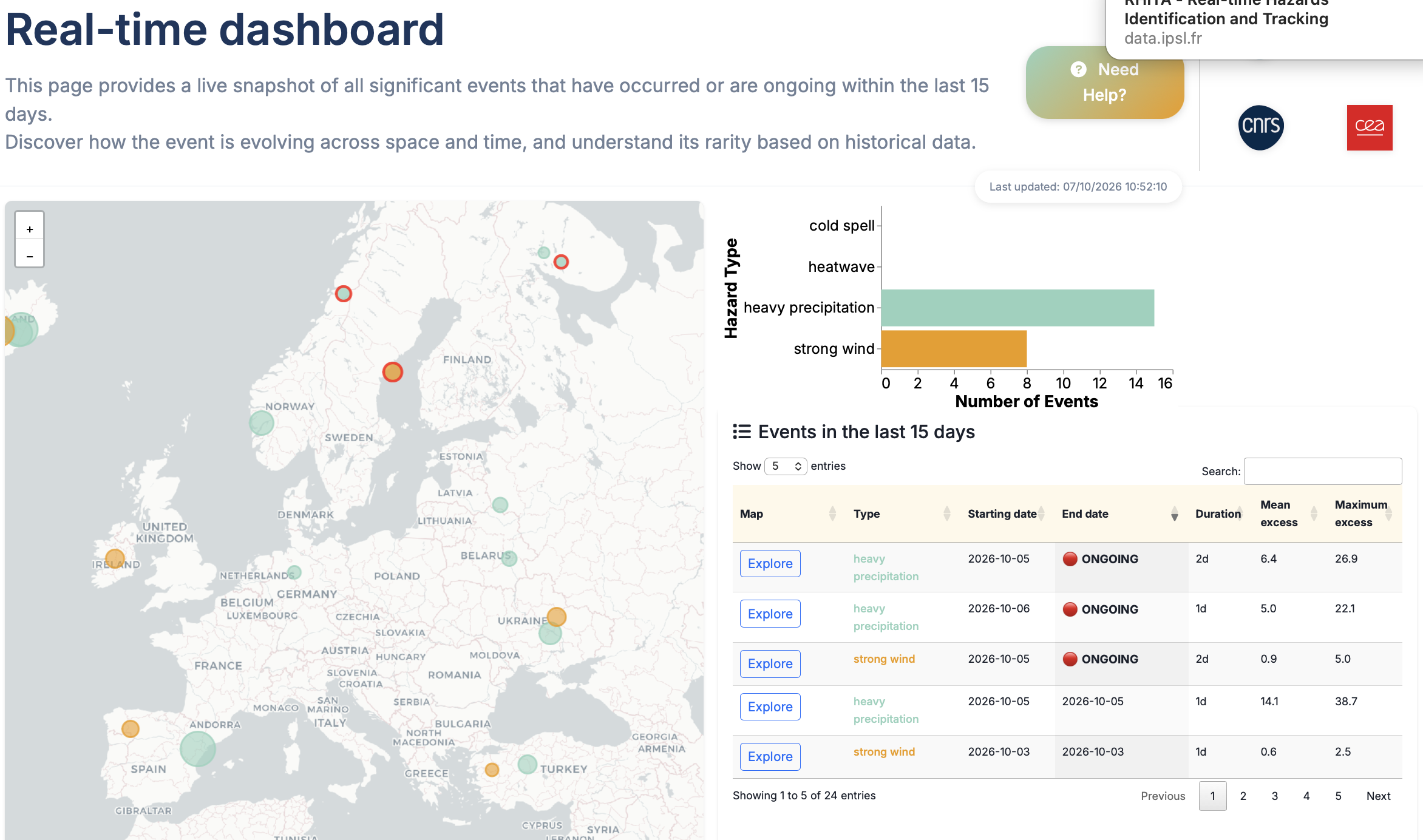
Figure: Real time dashboard of significant extreme weather events observed across Europe over the past 15 days. It allows users to track their evolution in space and time and assess their intensity relative to historical events.
A new study published in Natural Hazards and Earth System Sciences presents RHITA (Real-time Hazard Identification and Tracking Algorithm), a new tool developed at IPSL to automatically detect and track extreme weather events. The method identifies areas where temperatures, precipitation or winds reach exceptional levels and then follows their evolution in space and time. RHITA focuses on four types of events: heatwaves, cold spells, heavy precipitation and strong winds.
The tool combines operational ECMWF weather forecasts for near-real-time monitoring with ERA5 reanalysis data to analyse past events. Each event is characterized using several indicators, including intensity, duration, spatial extent and rarity relative to conditions observed since 1950. This approach makes it possible to compare an ongoing event with similar events in the historical record and to better characterize its exceptional nature.
Applied to ERA5 data over the 1950-2024 period, RHITA identifies 760 heatwaves, 681 cold spells, 805 heavy precipitation events and 686 strong wind events across Europe. The analysis reveals a statistically significant increase in heatwave frequency across all four European regions considered. Heatwaves have also become more intense and affected larger areas. In contrast, cold spells have become less frequent. Changes in heavy precipitation and strong wind events are more heterogeneous across regions and event characteristics.
RHITA is available through a web interface that allows users to visualize recent events, explore their evolution and access a historical archive dating back to 1950. The associated code and data are also openly available, facilitating their reuse for research and extreme-event analysis. The study was supported by the PowDev project of the PEPR TASE and the EXTENDING project of the PEPR TRACCS. The tool can help characterize ongoing weather events rapidly and place them within their longer-term climatic context.
Reference: Cazzaniga, G., Akakpo-Numado, A., Brockmann, P., Burq, A., Vrac, M., and Faranda, D. (2026). RHITA: a web tool for real-time detection of extreme weather events. Natural Hazards and Earth System Sciences, 26, 4741-4752. https://doi.org/10.5194/nhess-26-4741-2026.