
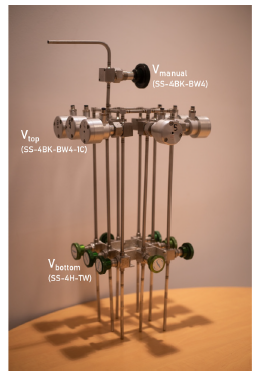
Climate reconstructions from ice cores strongly rely on analysing the elemental and isotopic composition of fossil air occluded in the ice, as these provide valuable dating tools and serve as proxies for past temperature variations. Traditional techniques for extracting and measuring atmospheric gases from ice cores typically involve liquid helium or cryogenic heads for gas trapping, both of which are expensive and complex to operate.
This study evaluates the use of silica gel as an alternative method, describing the design and optimisation of a trapping and detrapping system suitable for measuring 𝛿15Nof N2, 𝛿18Oof O2, 𝛿(O2∕N2) and the elemental and isotopic ratios of heavy noble gases, including Ar, Kr, and Xe. Systematic fractionation effects introduced by silica gel are quantified through long-term monitoring of atmospheric air, and correction and calibration protocols are developed to ensure measurement precision.
For measurements of atmospheric 𝛿15N, 𝛿18O, 𝛿(O2∕N2), and 𝛿40∕36Ar , the method achieves precision comparable to helium-based techniques when applied to high-quality ice. This supports the viability of silica gel trapping for future analyses of atmospheric permanent and noble gases from deep ice cores.
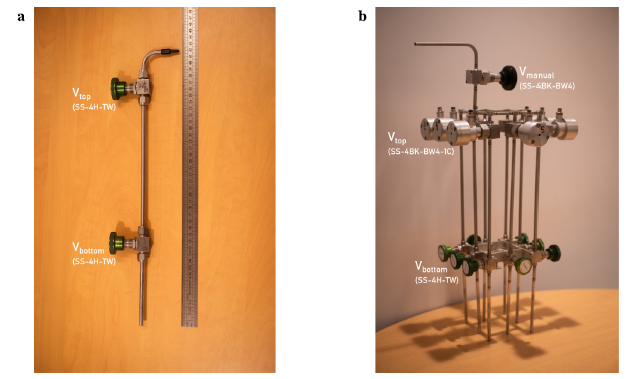
Authors: Anna Klüssendorf, Romilly Harris Stuart, Louisa Brückner, Frédéric Prié, Elodie Brugère, Anaïs Orsi, Roxanne Jacob, Claire-Mathilde Stücki, Louise Crinella Morici, Elise Fourré, Soizic Salaün, Amaëlle Landais
International Journal of Mass Spectrometry 523 (2026) 117606, https://doi.org/10.1016/j.ijms.2026.117606