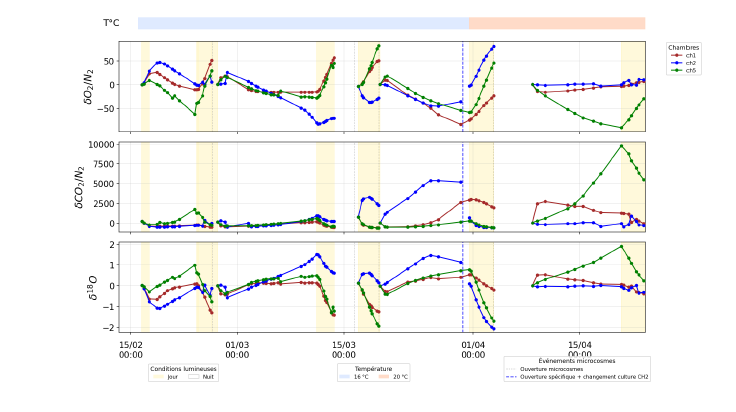
Interactions between the biosphere and climate are central in the current context of climate change. Biological productivity influences the isotopic composition of atmospheric dioxygen, particularly δ¹⁸O, used as a tracer of past biosphere changes. This internship aimed to better constrain oxygen isotopic fractionation associated with respiration and photosynthesis, and its variability depending on temperature and the organisms studied. The work relied on the AQUA-OXY device, composed of closed aquatic biological chambers allowing O₂, CO₂ and δ¹⁸O variations to be monitored. The study mainly focused on Phaeodactylum tricornutum, a model marine diatom, before being extended to Tetraselmis sp., Limnospira sp. and Picocystis sp. Respiration-related discrimination factors are relatively well constrained at 16 °C in P. tricornutum, with an average value close to −18,1 ‰. In contrast, photosynthetic discrimination factors remain more variable and strongly depend on calculation assumptions, particularly the correction applied for concomitant respiration. First comparisons suggest a possible variability depending on species and temperature, which must be confirmed by further experiments.