
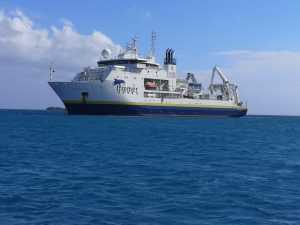
In 2021, a groundbreaking discovery in the field of ocean science was made off the coast of Mayotte by a scientific team (including the OCEANIS team) aboard the French Oceanographic Fleet’s *Pourquoi Pas?* during the GeoFLAMME expedition.
In 2021, a groundbreaking discovery in the field of ocean science was made off the coast of Mayotte by a scientific team (including the OCEANIS team) aboard the French Oceanographic Fleet’s *Pourquoi Pas?* during the GeoFLAMME expedition. More than 120 clusters of CO2 hydrates were observed. Never before had such a site been observed. This accumulation is likely linked to CO2 emissions from Fani Maoré, an underwater volcano formed in 2018 and discovered by a French multidisciplinary team (IPGP, BRGM, Ifremer, CNRS, IPG Strasbourg, and the University of Clermont-Ferrand) during the first MAYOBS1 oceanographic expedition, which was designed to study the origin of the intense seismic activity observed on the island of Mayotte since May 2018.
“This is the first time we have observed CO2 hydrates stable over several years on the ocean floor, of this size and in such quantities. This exceptional discovery raises new questions about the formation of hydrates and the sequestration of carbon dioxide by the ocean in the form of hydrates. This is a discovery that will enrich the scientific community and fuel the sector interested in CO2 storage in hydrates as a geoengineering solution for climate change mitigation,” emphasizes Cécile Cathalot, a marine geochemist at Ifremer’s Geo-Ocean laboratory (CNRS/Ifremer/UBO) and the study’s lead author.
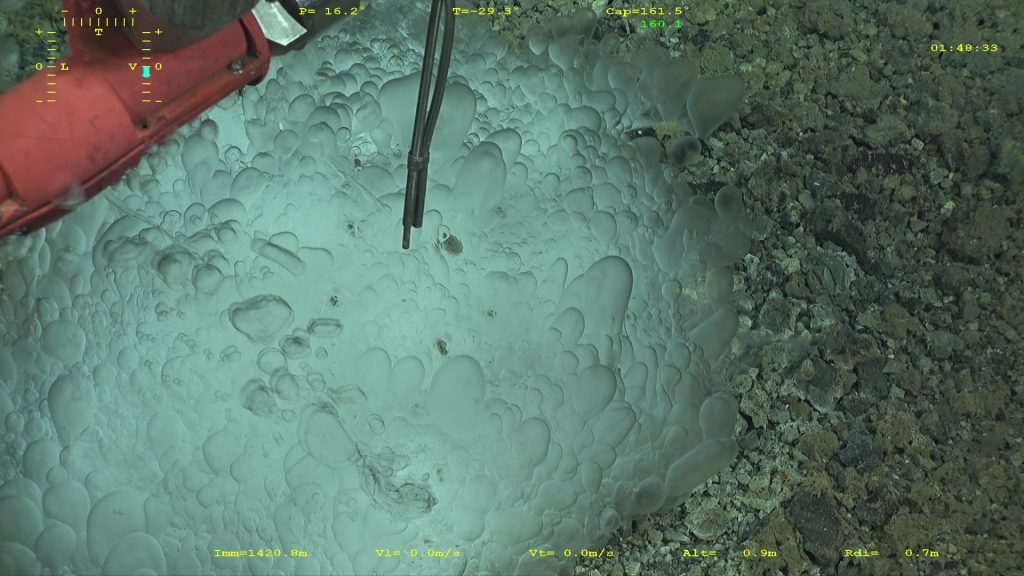
Hydrates are solid compounds similar to ice, composed of water and gas molecules. In nature, hydrates are often composed of methane, and it is extremely rare to find carbon dioxide hydrates on the ocean floor. Gas hydrates are generally found buried in sediments; these underwater domes, ranging from a few centimeters to 5 meters in height, had never been documented before.
The hydrates were observed within the “Fer à cheval” underwater volcanic structure, a 6 km² underwater feature surrounded by cliffs reaching up to 250 meters in height and located 10 km east of the island of Mayotte. This site offers the conditions necessary for hydrate formation, with a combination of cold water (4°C) and sufficient pressure exerted by the water column at a depth of 1,400 meters. This unique site will serve as a natural laboratory for studying the processes of temporary CO2 sequestration in the ocean and the adaptation of biodiversity to the environment’s acidic conditions, according to the study conducted by a multi-agency team and published in the journal Nature Geosciences on June 12.
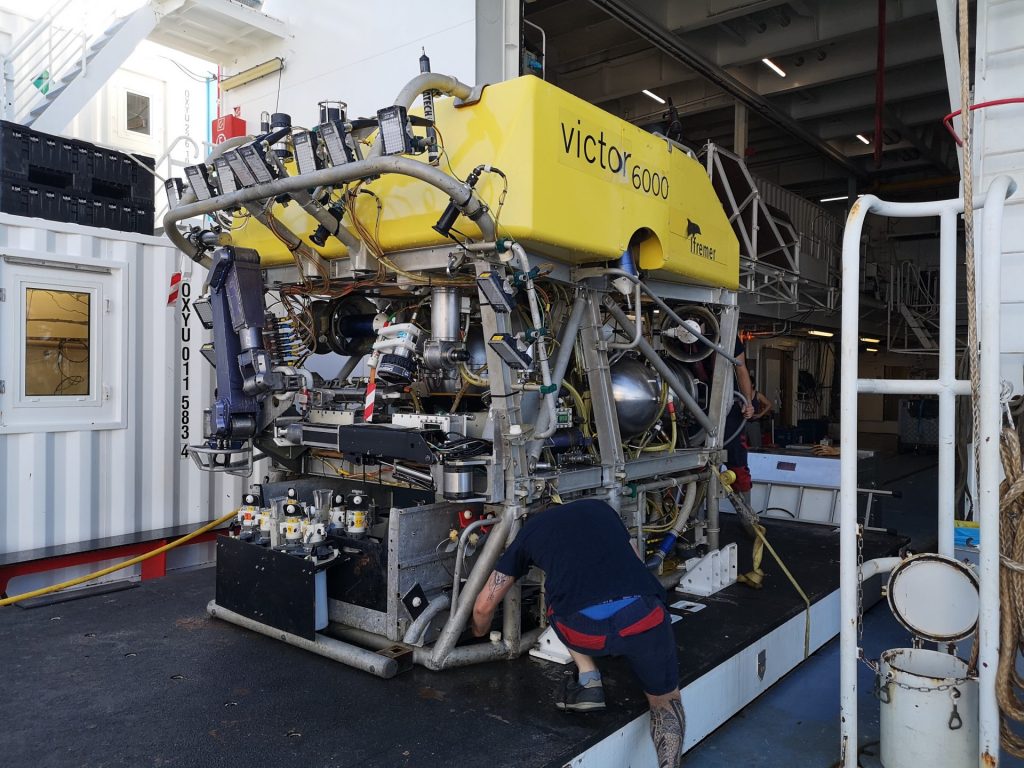
In this study, we combine acoustic surveys with optical and geochemical observations collected using an unmanned underwater vehicle (the Victor 6000 ROV) to show that mounds of CO₂ hydrates are forming directly on the seafloor, above a vast field of liquid CO₂ seeps off the coast of Mayotte. These emissions, which began following the volcanic activity of 2018, have a detrimental impact on surrounding coral communities due to local acidification.
“Thanks to the campaign’s observations, we identified about twenty species related to the coral group and noted increased mortality near the mounds. To better understand local biodiversity and its response to ocean acidification, we need to go further with more systematic and in-depth sampling,” emphasizes Marjolaine Matabos, a researcher in benthic ecology at Ifremer.
The study was conducted in partnership with researchers from IFREMER, IPGP, CNRS, CEA (LSCE – OCEANIS Team), NOAA, and the University of Milan.