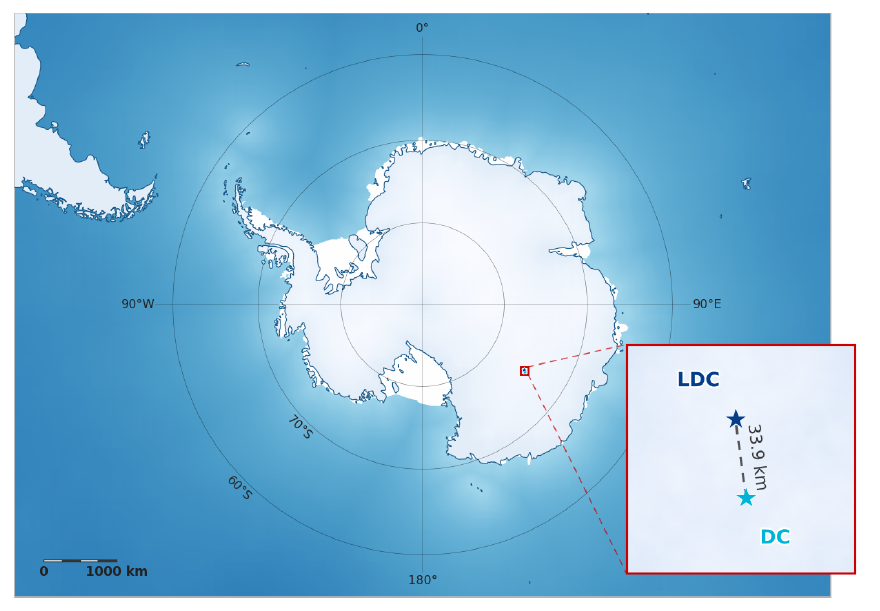
The European Beyond EPICA drilling project aims to obtain a continuous climate record over the past 1.5 million years from an ice core drilled at the Little Dome C (LDC) site in Antarctica. The goal of this internship was to reconstruct the local temperature evolution over the last 1.2 million years by combining water isotopes and gases trapped in air bubbles. To achieve this, the water isotope signal was first corrected for variations in ocean composition and past elevation changes of the ice sheet. Then, I participated in laboratory measurements on the inert gases of the ice core (δ15N and δ40Ar) and I used a numerical firn densification model to test several isotope-temperature slope scenarios using these gas measurements. The simulations show that the Werner slope (6.52◦C/ka) is the one that best matches our gas measurements. This final temperature clearly shows the succession of glacial and interglacial periods. It is close to the temperature reconstructed from a marine sedimentary core, but still presents some differences, such as stronger amplitudes in Antarctica.