25/11/2025: PhD defense of Titouan Tcheng directed by Amaelle Landais and Elise Fourré
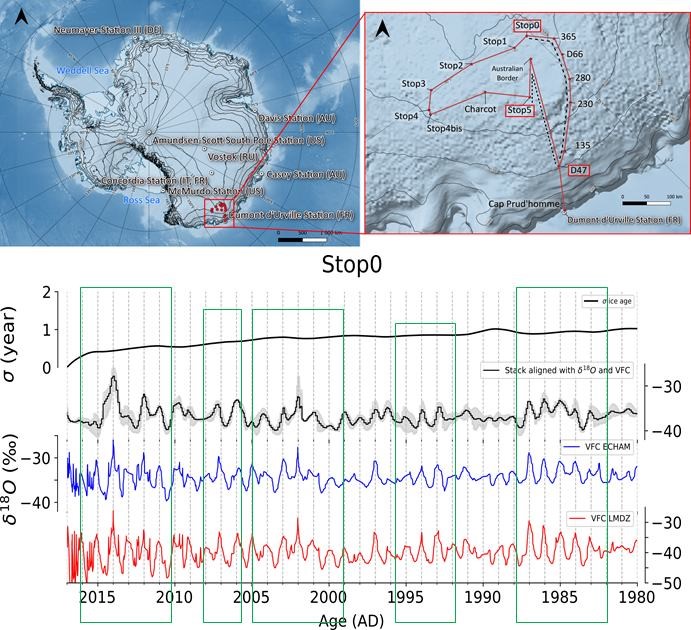
Stable isotopes in water are widely used as tracers of past temperature variability in Antarctica. However, the link between isotopes and temperature is not direct: surface processes (erosion, sublimation, wind redistribution), archiving processes (diffusion), and pre-depositional processes (origin of air masses, altitude, humidity) can significantly reduce the proportion of the signal explained by temperature, particularly in coastal areas. In this thesis, the isotopic compositions of nine firn cores (20 to 40 m deep, covering the period from 1979 to 2016) drilled in 2016 at three sites in coastal Adélie Land (East Antarctica) are compared with those obtained by modeling virtual firn cores (VFC) using general atmospheric circulation models that take isotopes into account. For two of the sites, the results show good agreement between the VFCs and the data, including at depths in the cores where diffusion affects the record. However, for the third site, which is particularly windy, the three individual cores did not allow a coherent signal to be reconstructed, as the wind induced too much stratigraphic noise in the isotopic signal. This thesis also made it possible to improve VFC models in the first 3 meters of firn cores by adding a description of the isotopic signal mixture caused by water vapor circulation in the open porosity of surface snow.