
The stable isotopes of water (δ¹⁸O and δD) analyzed in Antarctic ice cores are key proxies for past temperature variations. However, their interpretation is strongly influenced by numerous processes that occur after snowfall on the surface and during the transformation of snowpack into solid ice. Diffusion—that is, the natural movement of water molecules between different layers of snow—is one of the main factors affecting the long-term preservation of the climate signal.
Extreme synoptic events characterized by exceptionally high temperatures can contribute disproportionately to annual snow accumulation and generate marked isotopic anomalies. This is particularly true of atmospheric rivers—which are relatively rare in polar regions such as Antarctica—that transport significant amounts of heat and moisture.
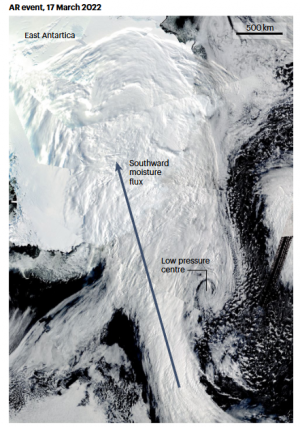
This research internship therefore aimed to study the preservation in snow of the exceptional atmospheric river that occurred in March 2022 and passed over the Dome C site on the East Antarctic Plateau. This event was characterized by a heat wave with temperature anomalies exceeding 40°C (Wille et al., 2024a). This caused a significant enrichment of the isotopic composition—more intense than the maxima observed in summer—which is likely to have a lasting impact on the signal preserved in the ice cores and, thus, to bias climate interpretations at temporal resolutions of up to five years.
To assess the persistence and evolution of this anomaly, isotopic profiles from snow pits collected in 2022, 2023, and 2025 at Dôme C as part of the NIVO project funded by the French Polar Institute; as well as those from 2024 collected at the Franco-Italian Concordia station and provided by G. Dreossi (EGU poster—Dreossi et al., 2025) were analyzed.
The degree of smoothing observed in the first few centimeters of the firn shows that the amplitude of the isotopic anomaly associated with the atmospheric river has halved over the course of three years. During this same period, the signal also broadened by nearly 5 cm, reflecting a rapid change in its initial structure due to diffusion. However, a comparison of the observations with the diffusion model described by Johnsen (1977) suggests that diffusion alone is not sufficient to explain the extent of the smoothing observed in this study. This discrepancy thus highlights the likely involvement of other post-depositional processes that may play a role in the evolution and preservation of the isotopic signal within the firn. Furthermore, a question arises regarding the long-term detectability of this type of synoptic event in the ice core record: despite the particularly pronounced amplitude of the initial anomaly, its rapid attenuation in the first few years following deposition could limit its identification to greater depths within the Antarctic ice sheet. In the context of global warming, the ability to identify and preserve the signature of such extreme weather events in ice cores could make it possible to trace their evolution over time and, ultimately, to better distinguish variations linked to natural climate variability from those that may be associated with human influence on their frequency and intensity.
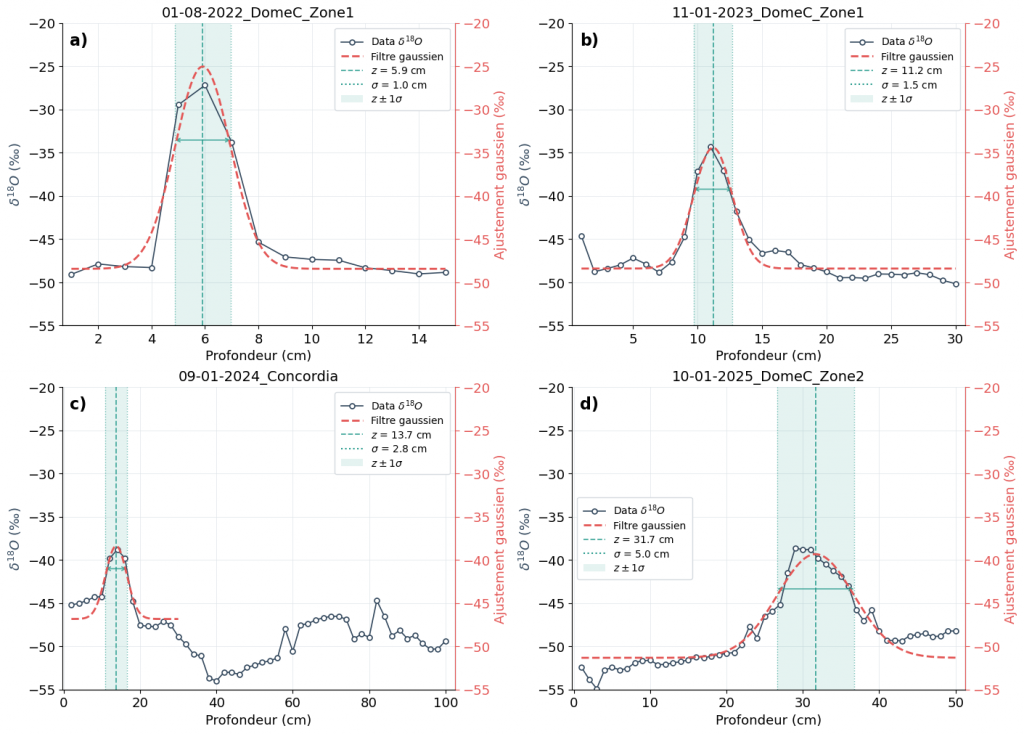
These analyses highlight the variation in diffusion length σ over time and depth, which was determined using a Gaussian function fitting method (determination of the standard deviation).
Angele Querec’s Master’s 2 internship under the supervision of Mathieu CasadoAngele Querec’s Master’s 2 internship under the supervision of Mathieu Casado