
PARIS, FRANCE – As researchers and policymakers evaluate various pathways to manage global temperatures, large-scale technological interventions are increasingly being studied alongside traditional emission reductions. While much of the literature focuses on Carbon Dioxide Removal (CDR) or Solar Radiation Modification (SRM), a new study published in npj Climate Action examines a distinct third option: Atmospheric Methane Removal (AMR).
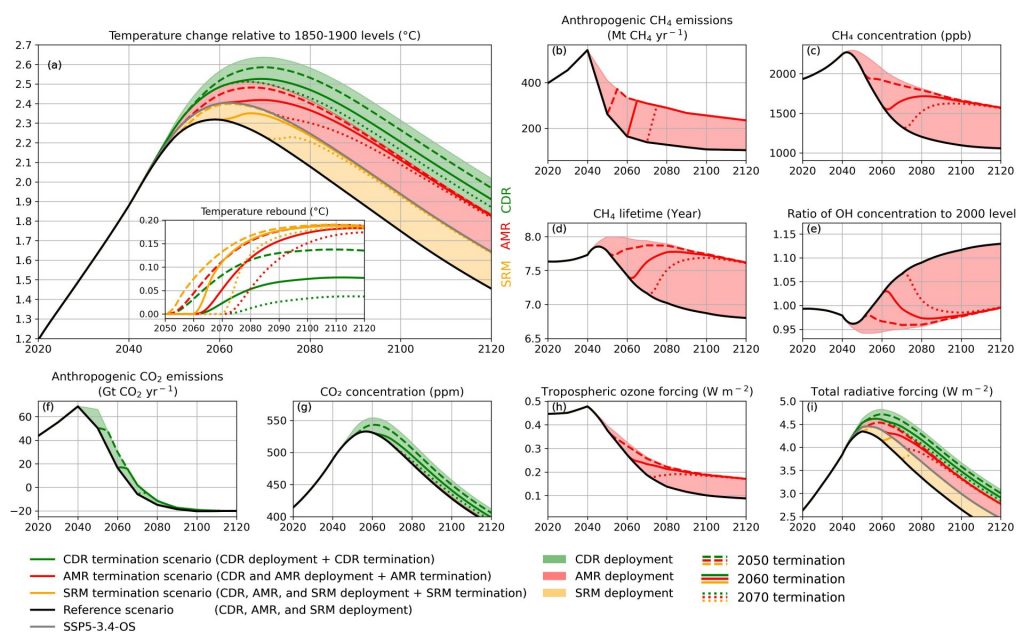
The research, conducted by an international team including scientists from the LSCE, explores how deploying and terminating AMR compares to CDR and SRM. Using a simplified global scenario-based approach, the study finds that while AMR can effectively lower temperatures, its climate benefits are not durable if the intervention is stopped. However, the study reveals that the temperature rebound from halting AMR is less abrupt than the notorious “termination shock” associated with SRM.
The “trio” of climate interventions: CDR, SRM, and AMR
The study highlights the differences among the three types of climate interventions:
- Carbon Dioxide Removal (CDR): Carbon dioxide is the primary driver of long-term climate change. It persists in the atmosphere for centuries and millennia, making permanent removal essential for long-term temperature stabilization, while deep CO2 emission reductions remain the most critical priority. Among various CDR approaches proposed, prominent examples are large scale afforestation and reforestation, bioenergy combined with carbon capture and storage, direct air capture, ocean alkalinity enhancement and enhanced weathering.
- Solar Radiation Modification (SRM): SRM—such as stratospheric aerosol injection—alters the radiative balance immediately, but stopping it risks a severe and rapid temperature spike, so-called termination shock. Its deployment carries the risk of unintended side effects on global weather and precipitation patterns.
- Atmospheric Methane Removal (AMR): AMR targets the short-lived but highly potent greenhouse gas. The concept has been proposed as a mechanism to lower peak global temperatures relatively quickly. While it has led to the launch of several early startups, technologies required to remove methane from the atmosphere remain in the early stages of scientific research. Proposed AMR approaches include photocatalytic methane reactors, atmospheric oxidation enhancement using hydroxyl radical and chlorine, ecosystem uptake enhancement, and building surface treatment.
Air Quality Links and Future Challenges
The researchers also investigated how AMR interacts with background air pollutants, such as nitrogen oxides, carbon monoxide, and volatile organic compounds. They found that under high-pollution scenarios, chemical interactions decrease methane levels, increase tropospheric ozone levels and, as a result, slightly enhance warming, with potential impacts on human health and ecosystems. However, the overall temperature rebound from AMR termination remains largely unaffected by these pollutant levels.
Crucially, the authors note that the study utilized a simplified modeling approach. They emphasize that it cannot fully capture strong, non-linear impacts on the entire chemistry system. Consequently, the researchers highlight an urgent need for the scientific community to investigate these air quality links using more complex Earth system models.
Looking Ahead: A New Research Agenda
Beyond quantifying these risks, the paper concludes by outlining a critical question for future research: could AMR eventually replace or reduce the reliance on the riskier solar geoengineering during temperature “overshoot” scenarios?
At the level of scientific research, the temporary use of SRM is being considered to shave off peak temperatures while long-term CO2 mitigation scales up. The authors propose investigating whether AMR, if it can be scaled up, could achieve a similar peak-shaving cooling effect without exposing us to the distinct physical risks associated with SRM.
“However, the atmospheric response to AMR termination is linked to air quality, meaning that the safety and effectiveness of methane removal depend on simultaneous global air pollution controls. Moving forward, we also need Integrated Assessment Models to map out future climate mitigation pathways including AMR,” said Katsumasa Tanaka at LSCE.
The discussion emphasizes the importance of integrated approaches. While the physical technologies required to scale AMR remain immature, the researchers conclude the need for coordinated policies across both climate mitigation and air quality management.
About the Study: The paper, titled “Atmospheric Methane Removal as a Third Climate Intervention: Termination Risks and Air Pollutant Effects,” is published in npj Climate Action. on 24 June 2026. doi:10.1038/s44168-026-00398-8