Context
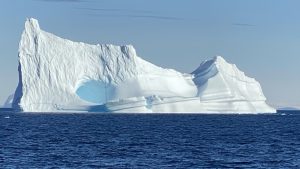
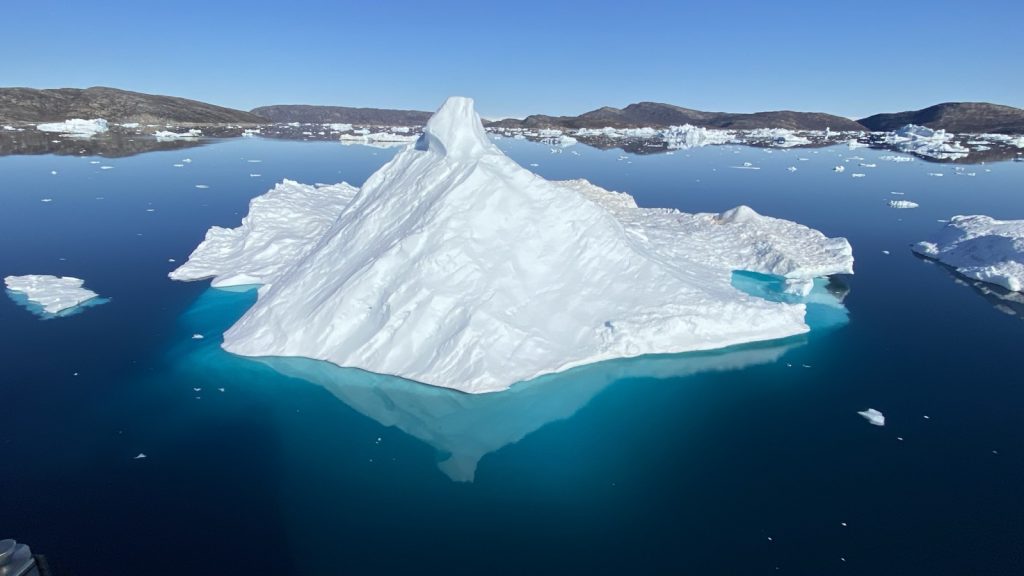
The Arctic is warming three times faster than the global average, causing Greenland’s ice sheet to melt rapidly. This adds freshwater and carbon to fjords, raising sea levels, lowering sea surface salinity, and accelerating the carbon cycle. Understanding these changes is crucial to predict how Arctic environments will evolve.
Arctic waters are highly sensitive to ocean acidification because cold, fresh meltwater absorbs more CO₂ and react more to this CO₂ addition than warmer, saltier waters. Retreating glaciers and increased freshwater flow alter fjord circulation and chemistry, potentially threatening coastal ecosystems and their productivity. Studying physical, chemical, and biological interactions in these areas is vital to anticipate changes in these fragile environments and to inform global climate and ecosystem models
The expedition
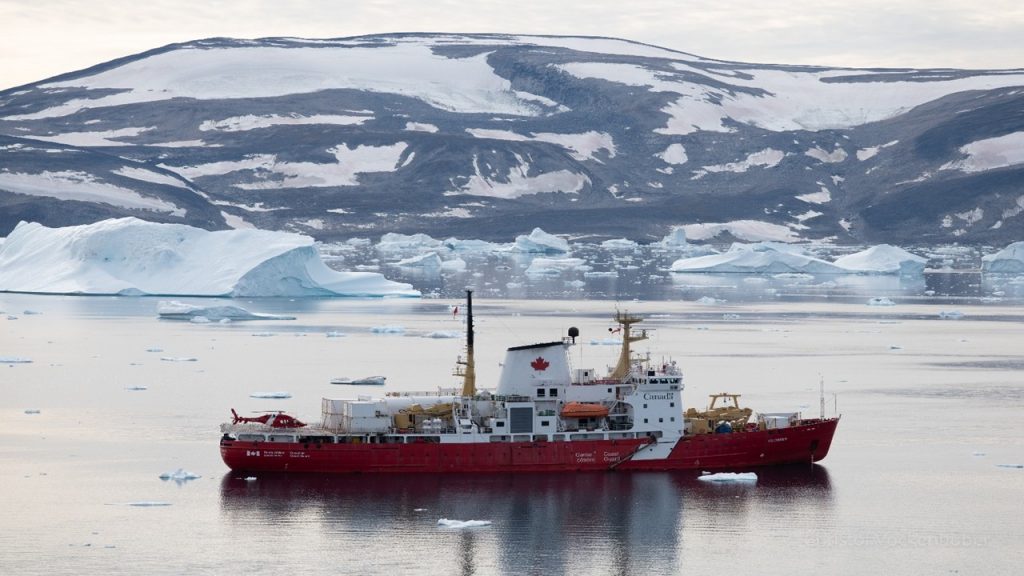
CASCADES is an international polar expedition uniting scientist from Canada, France, Greenland, and Switzerland to confront a critical climate challenge: the accelerating melt of Greenland’s glaciers and its far-reaching impacts on the Atlantic Ocean and climate systems worldwide. The CASCADES Expedition is coordinated by the Institut Nordique du Québec (INQ), the Swiss Polar Institute (SPI), and the French Polar Institute (IPEV), in collaboration with Greenlandic institutions and the Transforming Climate Action program for the Canada First Excellence Research Fund. It benefits from the infrastructure provided by the Canadian Coast Guard which operate the research icebreaker CCGS Amundsen, in close collaboration with Amundsen Science. This expedition is happening in two steps:
- In the summer of 2026, the CCGS Amundsen travelled within Baffin Bay and along the West coast of Greenland, enabling sampling along oceanographic transects and across a latitudinal range of glacier-fjord systems, with potential for land deployments.
- In the fall of 2026, the expedition will focus on sea-ice formation in western Baffin. Four stations will be set-up which locations depending on ice-condition, and land deployments possible opportunistically
The CARAMBAR project
The CARAMBAR project is part of the international oceanographic mission CASCADES, which took place from August 6, 2026, to September 3, 2026. In this first phase, CARAMBAR is studying carbon sources and sinks along Greenland’s fjords and examining the impact of Arctic warming on them. It tracks the path of freshwater from rivers, glaciers, and sea ice using oxygen isotopes and by measuring total alkalinity and pH. Sediment cores are used to quantify carbon storage on the seafloor. This approach establishes a link between land and sea, connecting glacier melt, water movements, and the carbon cycle in the rapidly changing Arctic fjords.
Over the course of 28 days, more than 400 samples were analyzed onboard to measure the pH and alkalinity of the water (representing approximately 1,600 analyses). Carbon isotopes, measured in the laboratory, make it possible to determine whether the carbon originates from the atmosphere, the land, or the ocean, and reveal its reactivity. Oxygen isotopes help identify the various sources of freshwater, such as precipitation, glaciers, rivers, or melting sea ice. Both inorganic and organic forms of carbon—whether dissolved or in particulate form—will be analyzed to quantify carbon fluxes and storage in the waters and sediments of the fjords.
Samples
Samples include seawater from the surface to the seafloor, meltwater from glaciers, lakes, rivers, and sea ice, as well as sediment cores and porewater. Sediment cores will be sectioned to measure sedimentation rates using natural and artificial radionuclides, providing insight into carbon sequestration over time (in collaboration with LEGOS and LAFARA.
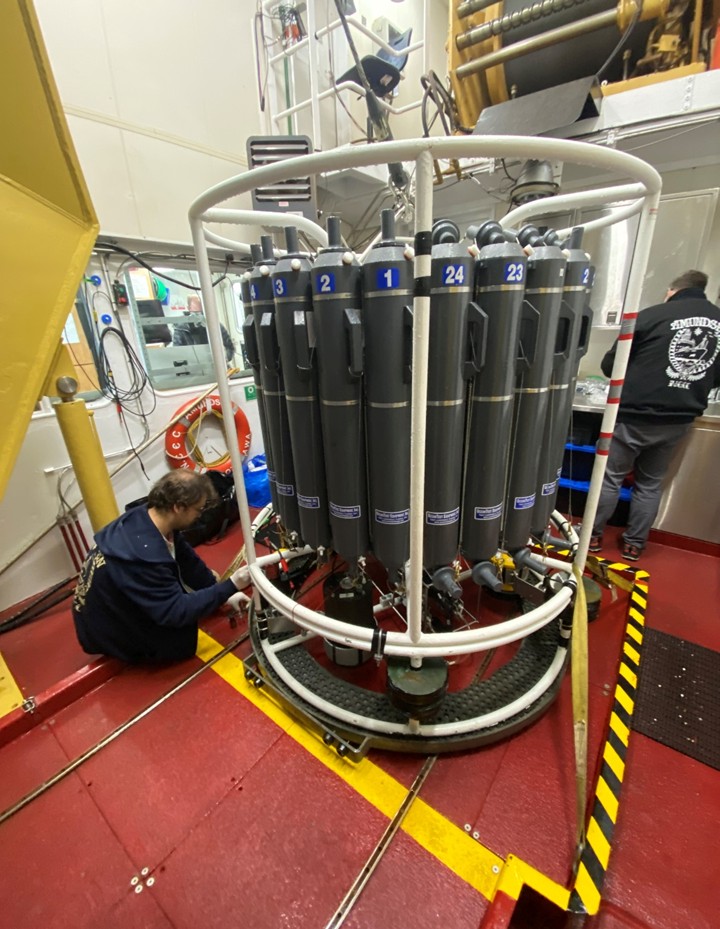
Members of the project : On board
- Bruno Lansard, Laboratory for Climate and Environmental Sciences, LSCE/UVSQ/Université Paris-Saclay, France
- Swan Schluk, Laboratory for Climate and Environmental Sciences, LSCE/UVSQ/Université Paris-Saclay, France
- Auguste Lugrin, Laboratoire d’Océanographie et du Climat : Expérimentations et Approches Numériques, Université Sorbonne, Paris, France
Other members of the project
- Pieter Van Beek, Laboratory of Space Geophysical and Oceanographic Studies, Toulouse Université 3, Toulouse, France
- Claire Waelbroeck, Laboratoire d’Océanographie et du Climat : Expérimentations et Approches Numériques, Université Sorbonne, Paris, France
The expedition site : https://cascades-expedition.science/
The CARAMBAR Project : https://cascades-expedition.science/projects/carambar/
The expedition map : https://cascades-expedition.science/map-of-the-expedition/