
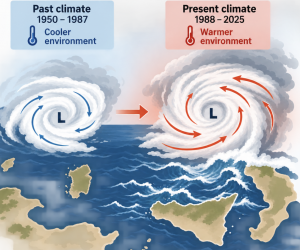
A new peer reviewed study finds that climate change strengthened the winds associated with Cyclone Harry, which affected the central Mediterranean in January 2026. The authors estimate that around 9% of wind related damages could be associated with climate change, with approximately 2.91 million people and US$63.58 billion in GDP exposed to wind hazards intensified by global warming.
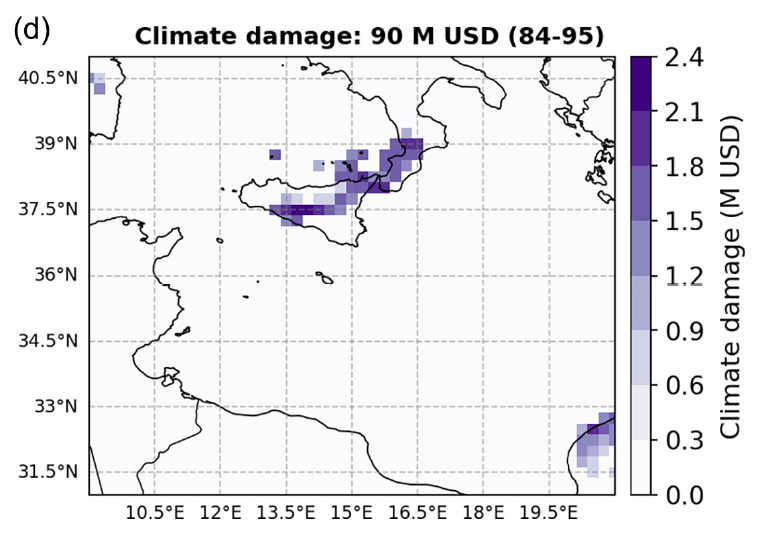
Figure: Climate-driven damages for cyclone Harry.
Cyclone Harry affected Sicily, Calabria and Sardinia between 19 and 22 January 2026, bringing heavy rainfall, strong winds and severe coastal impacts across the central Mediterranean. Waves reached around 9 to 10 metres along exposed coastlines, while flooding, erosion and damage to transport networks and coastal infrastructure caused widespread disruption.
A new study led by Davide Faranda, Marco Zanchi and Tommaso Alberti, published in the Quarterly Journal of the Royal Meteorological Society, investigates whether and to what extent human induced climate change intensified the meteorological conditions and wind related impacts associated with Cyclone Harry.
Using the ClimaMeter attribution framework, the researchers compared atmospheric configurations similar to Cyclone Harry in the present day climate (1988–2025) with comparable events in an earlier, cooler climate (1950–1987). The analysis shows that similar large scale atmospheric circulation patterns occurred in the past, but that they now develop in a substantially warmer environment.
“Cyclone Harry was an exceptional event, but its large scale atmospheric configuration was not entirely unprecedented,” explains Davide Faranda, CNRS researcher and lead author of the study. “What has changed is the climate in which such a cyclone develops. For comparable atmospheric configurations, we find temperatures around 1 to 2°C higher over Sicily and the surrounding Mediterranean, together with a modest deepening of the cyclone at sea level. This warmer background can modify the storm response and contribute to more severe surface impacts.”
The clearest climate change signal concerns wind. Present day analogues show near surface winds around 4 to 6 km/h stronger over eastern Sicily and the adjacent Mediterranean, with locally larger increases. Stronger low level winds can contribute to higher waves and consequently increase coastal flood risk. Changes in precipitation are more heterogeneous and less robust, meaning that the main attribution result of the study concerns wind related hazards rather than rainfall.
“A relatively small change in wind speed can have disproportionately large consequences when an extreme storm affects densely populated and highly exposed coastal areas,” says Marco Zanchi, researcher at LSCE/IPSL and co lead author of the study. “This is why we wanted to go beyond the meteorological signal. Climate attribution becomes particularly relevant for society when we can identify where a climate amplified hazard overlaps with people, cities, infrastructure and economic activity.”
The researchers therefore combined the climate attribution analysis with spatial information on population and GDP. They estimate that approximately 2.91 million people and US$63.58 billion in GDP were located within areas exposed to wind hazards significantly intensified by climate change. Most of this exposure occurred within the highest hazard category, particularly in Sicily, the Strait of Messina and southern Calabria.
The study then introduced an impact based diagnostic to estimate how the climate related increase in wind could translate into economic losses. Assuming an illustrative total wind damage of US$1 billion, the model estimates that around US$90 million, or approximately 9% of the total, could be associated with climate driven amplification of the hazard.
“This is an important step because climate attribution should ultimately help us understand not only how an extreme event has changed, but also what that change means for society,” explains Tommaso Alberti, researcher at the National Institute of Geophysics and Volcanology (INGV) and co author of the study. “Our estimate suggests that climate driven amplification of wind can already translate into a measurable additional economic burden. In highly exposed areas such as eastern Sicily and the Strait of Messina, stronger winds can also interact with waves, storm surge and coastal flooding, potentially producing compound impacts that are much larger than those associated with any single hazard, affecting coastal populations, critical infrastructure and the coastline itself.”
The findings also raise questions about the future of Mediterranean cyclones. Current research does not necessarily indicate that the overall number of Mediterranean cyclones will increase. However, more intense systems could develop stronger near surface winds and greater damage potential in a warmer climate.
“The next question is what a cyclone similar to Harry might look like in the Mediterranean in the coming decades,” concludes Faranda. “Our study is based on an event that has already occurred and does not provide a future projection. However, if the Mediterranean and lower atmosphere continue to warm, the thermodynamic environment in which these storms develop will continue to change. High resolution climate simulations will be essential to determine whether events similar to Harry could become more intense and, importantly, how their economic and societal impacts could evolve under different emissions scenarios.”
The authors stress that the economic estimate considers only wind related losses. Cyclone Harry was a compound event in which rainfall, waves, coastal flooding and other processes contributed substantially to the overall damage. The study does not attribute these additional components to climate change.
Future research will extend this framework using high resolution climate simulations capable of better resolving Mediterranean cyclones and their interaction with complex coastlines, mountains and hills. Such simulations could help assess changes in the frequency and intensity of events similar to Harry under different emissions scenarios and translate these changes into forward looking estimates of socioeconomic risk.
The research was supported by the European Union’s Horizon 2020 programme through XAIDA, and by the French ANR projects PowDev, Templex and TRACCS-PC4-EXTENDING, as well as the COST Actions FutureMed and MEDUSSE. Tommaso Alberti received funding from the Italian Ministry of University and Research through the Italian Fund for Science 2022–2023 (FIS-2), for the project “Mediterranean Extreme Events and Tipping elements in a changing climate on multiple spatiotemporal scales” (FIS-2023-00159; CUP D53C24005450001).
Article Reference
Faranda, D., Zanchi, M. & Alberti, T. (2026) Climate-change-amplified wind-related economic losses during Cyclone Harry (2026). Quarterly Journal of the Royal Meteorological Society, e70314. Available from: https://doi.org/10.1002/qj.70314