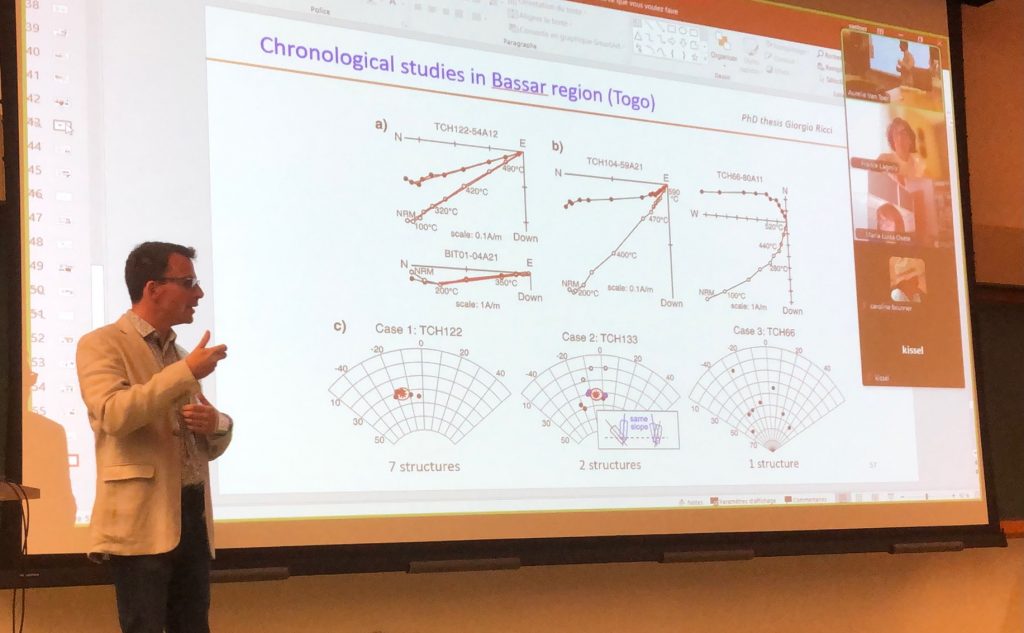
On June 6, 2025, Gwenaël Hervé successfully defended his Habilitation à Diriger des Recherches at Paris-Saclay University!
“Between geomagnetism and archaeology: studies on the secular variation of the Earth’s magnetic field during the Holocene”
His research focuses on secular variations in the geomagnetic field over the past few millennia, which he reconstructs by studying the magnetic properties of archaeological terracotta artifacts. His work aims to develop more reliable global geomagnetic models by improving the archaeomagnetic database. Resolutely interdisciplinary, my work has applications both in geomagnetism—in understanding the functioning of the geodynamo in the outer core—and in archaeology, by providing a new dating tool.
Gwenaël’s approach relies on the acquisition of new direction and intensity data, the critical analysis of existing data, and the construction of regional secular variation curves using a Bayesian method. To date, his main work has focused on variations during the first millennium BCE in Western Europe and Mexico. He has been able to clarify the very strong and rapid variation observed during this period in relation to the Iron Age Levantine anomaly. This work was made possible by the establishment of a significant network of collaborations in archaeology.
In the coming years, Gwenaël’s main projects will be based in sub-Saharan Africa, a key region to understand current trends but one where data is very scarce. He will work primarily in the Horn of Africa and West Africa on archaeological contexts associated, respectively, with the emergence of the first productive societies and iron metallurgy. In Western Europe, the goal is to obtain a high-resolution record spanning eight millennia by extending secular variation curves into the Neolithic period. These two projects, which will involve studying new types of structures, will, among other things, help constrain the possible range of secular variation, trace the history of the South Atlantic Anomaly, test the stability of the current structure of surface flows within the core, and put the current decrease in the dipole moment into perspective within the longer-term variation of the geomagnetic field.
In the future, Gwenaël plans to focus his research on studying variations during the last glacial/interglacial cycle through the analysis of volcanic flows, archaeological structures, and, above all, marine sediments.
Abstract and manuscript ici