
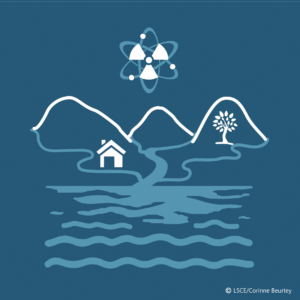
The Cook Glacier, which covers part of the main island of the Kerguelen Archipelago (French Southern and Antarctic Lands), has been melting at an accelerated rate since the 1960s in response to global warming. The fjord of Table Bay – a system fed with water and sediments by melting ice – constitutes an ideal archive of environmental changes in this region. Analysis of a sedimentary core collected from this fjord in 2009 during an expedition by the Marion Dufresne (French Oceanic Fleet – FOF) has, for the first time in the southern Indian Ocean, revealed the presence of traces of nuclear fallout associated with the nuclear tests carried out by France between 1966 and 1974 in Polynesia, thereby validating and refining the age model of this sedimentary sequence. Indeed, in addition to the 137Cs fallout associated with all atmospheric nuclear tests, traces of plutonium exhibiting an isotopic signature (240Pu/239Pu) consistent with that attributed to the French tests were found there. These results were corroborated by the use of two reference techniques for plutonium analysis (accelerator mass spectrometry – AMS – and inductively coupled plasma mass spectrometry – ICP-MS), which yielded consistent results. Thanks to this validated dating, it has been possible to accurately reconstruct the presence of other anthropogenic contaminants on this isolated island and their evolution over recent decades.
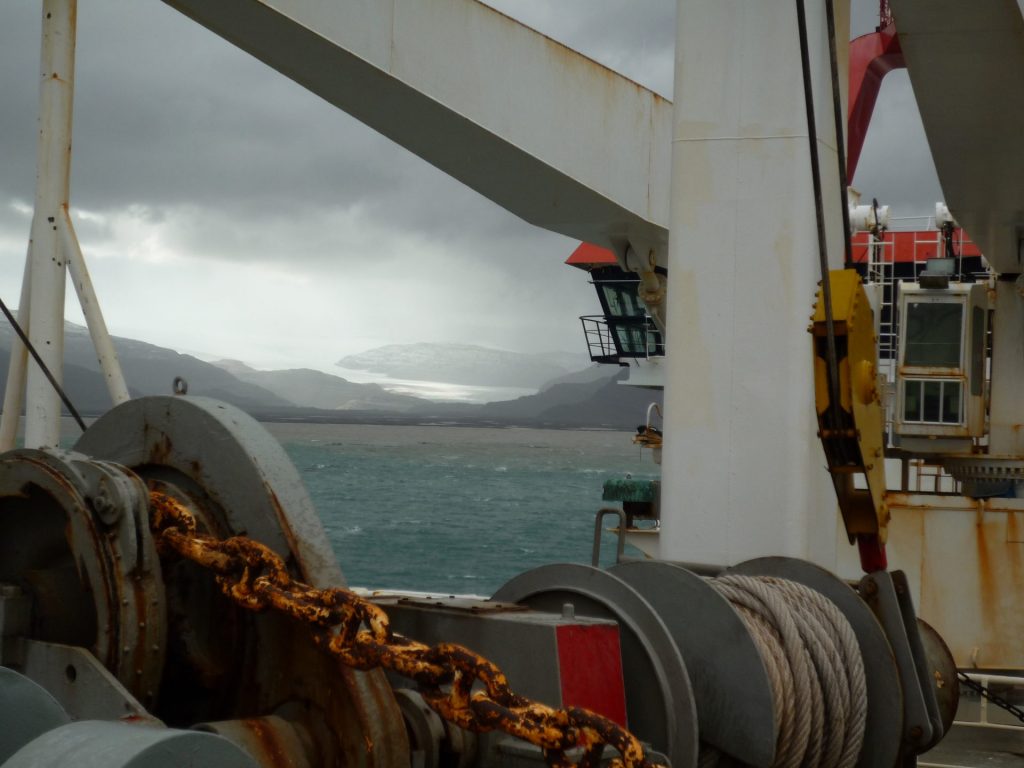
Photograph taken during the CAVIAR oceanographic expedition in 2009 (Source: E. Michel, LSCE)
We were thus able to demonstrate the impact of the melting of the Cook Ice Cap on the remobilisation of anthropogenic lead, the transport of which to the fjord across the proglacial lake was facilitated by the melting ice. Analysis of the trajectories of air masses in the region and of the isotopic signature of the lead found in the sediment core indicates that it is associated with historical contamination, likely linked to industrial activities in South Africa and the rise in the consumption of leaded petrol in the region from the 1940s onwards. A review of the literature also indicates that South Africa is likely the main source of air pollution in this region.
Analysis of a wide range of contaminants has revealed more recent contamination, dating from 2001, with arsenic, molybdenum, antimony and various persistent organic pollutants (POPs). Thus, all the POPs tested were detected only in the most recent sediment layer (2005–2007). Light PAHs and polybrominated diphenyl ethers (PBDEs; used in particular as flame retardants in plastics and textiles) were found, which supports the hypothesis that they have been transported over long distances at the global scale or from South Africa.
In future, these findings – which corroborate other evidence regarding the long-range transport of contaminants to the most remote corners of the globe – could be updated through the analysis of other sedimentary records collected more recently.
These results were made possible thanks to collaboration between various laboratories in France (LSCE/Laboratory of Climate and Environmental Sciences, METIS/Environmental Media, Transfers and Interactions in Hydrosystems and Soils, GEODE/Environmental Geography), the University of Basel (Switzerland), the University of Vienna (Austria) and the University of Quebec at Trois-Rivières (Canada).