
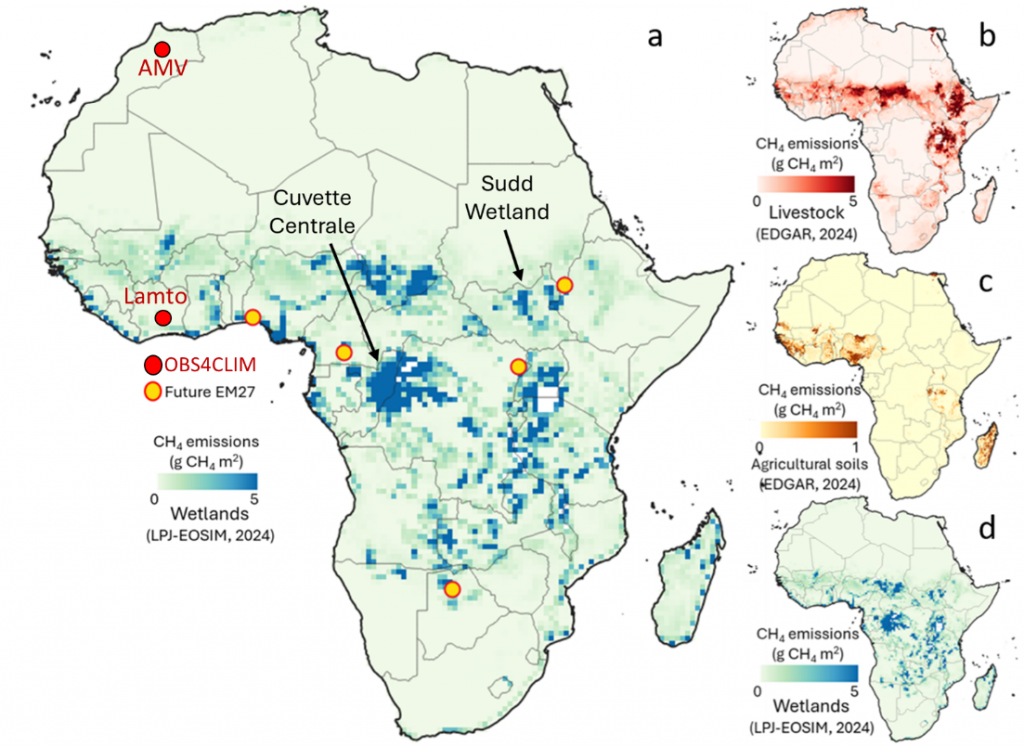
Methane emissions have a significant impact on global warming in short term, but they remain one of the most uncertain elements in the global greenhouse gas budget. Recent research identifies the African continent as a key factor in the accelerating growth of atmospheric methane (Ciais et al., 2026). The continent is home to diverse and poorly quantified sources, including forest fires, large wetlands such as the Cuvette Centrale and the Sudd, major river systems and deltas such as the Okavango, as well as growing anthropogenic emissions from livestock farming, agriculture, the oil and gas sectors, and landfill sites. The latest Regional Carbon Cycle and Processes Assessment (RECCAP2) estimates African emissions at between 74 and 87 Tg of CH₄ per year (approximately 15 per cent of global totals; Ernst et al., 2024), but uncertainties remain too high to reliably attribute emissions across different sectors, which complicates efforts to track climate feedbacks and inform mitigation measures under the Global Methane Pledge (GMP).
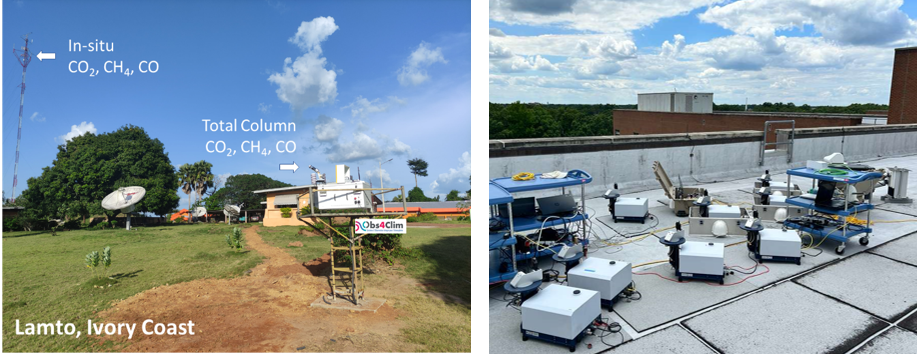
To reduce uncertainties, atmospheric observations across the African continent will need to be expanded. This objective faces a number of logistical, human and economic challenges. The deployment of a network to measure surface greenhouse gas concentrations, similar to the ICOS network in Europe, is primarily hampered by the difficulty of identifying the necessary infrastructure (typically towers around 100 metres high) to achieve regional, rather than local, spatial representativeness. An alternative is to deploy sun-tracking Fourier transform infrared (FTIR) spectrometers, which enable total column measurements that are less sensitive to local disturbances. We have therefore deployed two total column measurement stations as part of the Equipex-OBS4CLIM project: one at Lamto in Ivory Coast, and the Atlas-Mohammed V station in Morocco. This emerging network will be developed by the CH4 ALERT (Africa Land Emissions Reporting & Tracking) project, coordinated by UCLA, which will enable the deployment of five FTIR spectrometers at strategically selected sites based on logistical considerations and work to optimise the atmospheric network (Li et al., 2026). This analysis has led us to select measurement sites in the following five countries: Cameroon, Nigeria, Rwanda, Ethiopia and Botswana, with the aim of installing the instruments in the first half of 2027.
Ciais, P., Y. Zhu, Y. Cai, X. Lan, S. E. Michel, B. Zheng, Y. Zhao, D. A. Hauglustaine, X. Lin, Y. Zhang, S. Sun, X. Tian, M. Zhao, Y. Wang, J. Chang, X. Dou, Z. Liu, R. Andrew, C. A. Quinn, . . . S. Peng (2026). Why methane surged in the atmosphere during the early 2020s. doi:10.1126/science.adx8262. Science, 391(6785).
Ernst, Y., Archibald, S., Balzter, H., et al. 2024. The African Regional Greenhouse Gases
Budget (2010–2019). Global Biogeochemical Cycles 38, no. 4: e2023GB008016.
https://doi.org/10.1029/2023GB008016
Li, H., Ciais, P., Chevallier, F., Zheng, B., Palmer, P., Hase, F., Lopez, M., Ordway, E., Peng, S., Monteverde, D., Ramonet, M., St. Clair, J. M., Sagang, L. B., and Poulter, B.: Strategic Design of Methane Observation Networks to Improve Emission Estimates: A Case Study in Africa, EGUsphere [preprint], https://doi.org/10.5194/egusphere-2026-1832, 2026.
Contacts : Michel Ramonet Morgan Lopez and Philippe Ciais