
Why it matters
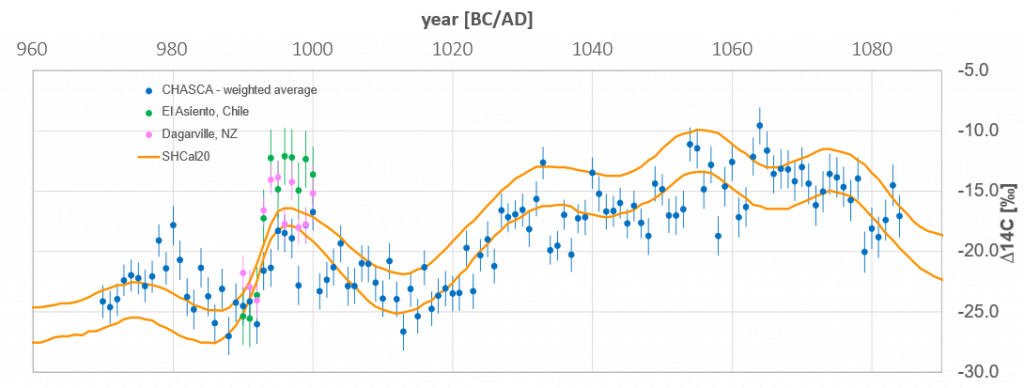
Tree-ring radiocarbon (14C) provides one of the most powerful archives for reconstructing past solar activity and atmospheric carbon dynamics. However, annually resolved records are overwhelmingly concentrated in the Northern Hemisphere, leaving major uncertainties for the South. This study presents the first annually resolved radiocarbon record from South America, spanning AD 970–1084 from Fitzroya cupressoides, one of the world’s longest-lived tree species. The new CHASCA record fills a critical geographical gap in the global radiocarbon network.
Our contribution
The LSCE led the CHASCA project, from the analytical strategy to the high-precision AMS radiocarbon measurements and data interpretation. The study also relied on R. Villalba’s expertise in dendrochronology and T. Stolarczyk’s contribution to the astrophysical interpretation of the radiocarbon signal.
At a glance
🌎 1 First annually resolved South American tree-ring 14C record
🌳 115 Years reconstructed (AD 970–1084)
☀️ AD 993–994 Extreme solar particle event detected at 7s
🌍 1 New benchmark for Southern Hemisphere radiocarbon calibration (SHCal)
Reference: Hatté C., Daux V., Hervé G., Labidi K., Phouybanhdyt B., Thil F., Villalba R., Stolarczyk T. (2026), Annual radiocarbon variability in southern South America recorded by Fitzroya cupressoides, AD 970–1084, Radiocarbon, doi:10.1017/RDC.2026.10233