
The slowdown of the Atlantic Meridional Overturning Circulation (AMOC) due to ongoing climate change raises concerns about its impact on the global carbon cycle. Understanding how global biosphere productivity may respond to such changes is essential for predicting the future carbon cycle, yet quantifying past global biosphere productivity remains challenging.
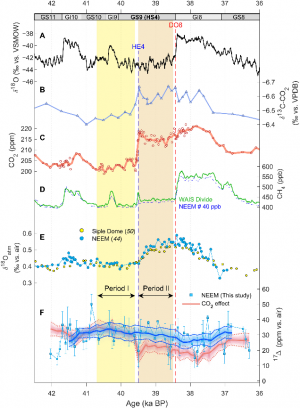
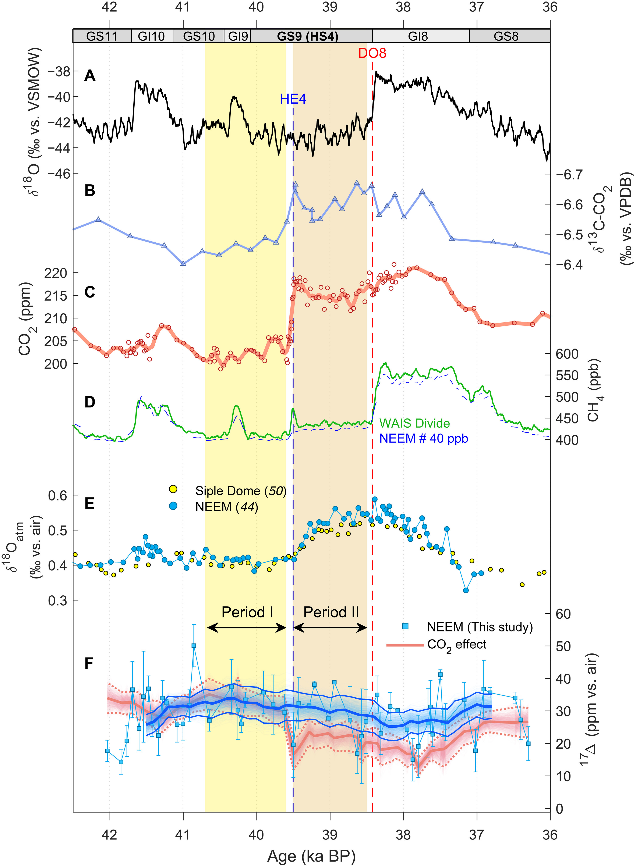
We use triple isotope composition of air oxygen (17Δ) trapped in polar ice cores to reconstruct the global biosphere productivity over the period 40.5 to 38.6 thousand years before the present (ka B.P.), covering Heinrich Stadial 4, a period of weakened AMOC. Our data reveal a slight increase in productivity following a carbon dioxide (CO2) rise around 39.5 ka B.P.
Freshwater hosing experiments using a global climate model indicate that the CO2 fertilization effect on the terrestrial biosphere offsets productivity decline caused by consequences of AMOC slowdown. Collectively, our results suggest that global biosphere productivity slightly increases in response to AMOC slowdown and accompanying changes.
Authorss: Ji-Woong Yang, Jean-Baptiste Ladant, Thomas Blunier, Amaëlle Landais, Masa Kageyama, Didier Paillard, Nicolas Viovy, Pascale Braconnot, María Fernanda Sánchez Goñi, […] , and Louise Crinella-Morici, Frédéric Prié, Sébastien Nguyen, and Louise Crinella-Moric
Science Advances – 15 Jul 2026 – Vol 12, Issue 29 – DOI: 10.1126/sciadv.aea0455