
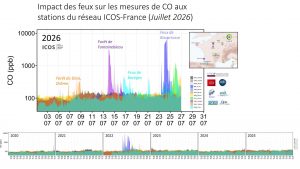
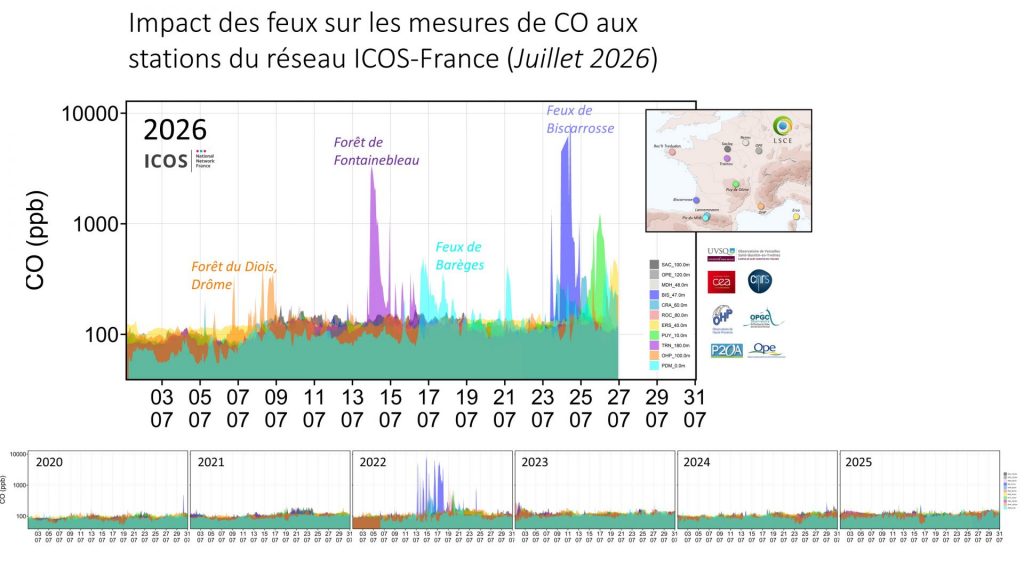
Carbon monoxide (CO) measurements reccorded at stations within the ICOS research infrastructure network reflect the intensity of the fires in France during July 2026. In turn, the Haute Provence Observatory (OHP), the stations at Trainou in the Forest of Orléans, Biscarosse in the Landes, Lannemezan at the foot of the Pyrenees, and also at the Pic du Midi de Bigorre at 2,877 metres, have recorded CO concentrations well above usual levels. Whilst concentrations recorded at these rural observatories typically range between 50 and 200 ppb, readings at the Biscarrosse station reached 25,000 ppb on 24 July. These very high concentrations at Biscarrosse are primarily due to the station being directly downwind of the fires, but it is clear that by 25 July the plume from these fires in the south-west had reached the Puy de Dôme observatory, with concentrations of up to 10,000 ppb, demonstrating the large-scale dispersion of the plumes emitted by the fires. The intensity of the signals observed this year at the ICOS stations is unprecedented since 2022.
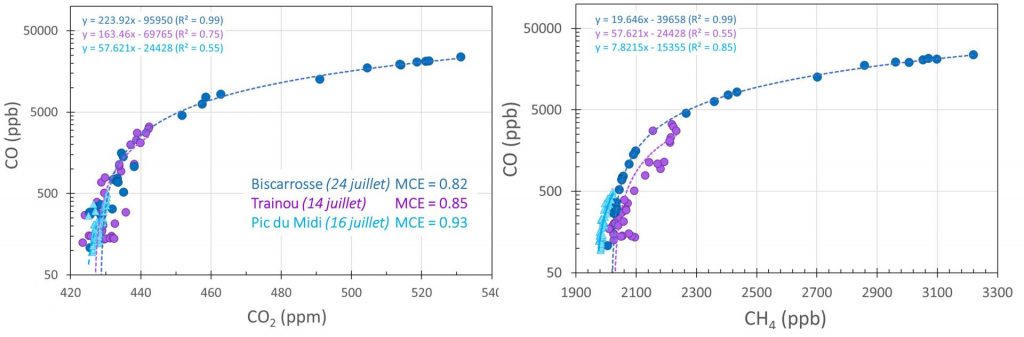
Carbon monoxide emitted by combustion is an indicator of smoke plumes from fires, but it is, of course, not the only compound emitted. The analysers in the ICOS network also measure carbon dioxide (CO₂) and methane (CH₄). The correlations between these gases and CO make it possible to characterise the chemical signature of the various smoke plumes. The MCE (Modified Combustion Efficiency) indicator, defined as the ratio ΔCO₂/(ΔCO₂ + ΔCO), makes it possible, for example, to classify the type of fires responsible for the signatures observed at the observatories. An MCE of 0.85 or less – as seen, for example, in the signals measured at Trainou and Biscarrosse – indicates emissions dominated by smouldering fires, whereas MCE values above 0.92 – as in the case of the Pic du Midi – are more indicative of intense fires. This distinction is important because plumes from smouldering fires have a greater impact on air quality due to higher emissions of various pollutants, such as volatile organic compounds and fine particulate matter, which are also measured at national observatories by the ACTRIS research infrastructure.
Contacts: Michel Ramonet and Morgan Lopez