
The study of caves allows to reconstruct climatic, environmental, geological, and even human population histories. In particular, the concretions that develop within caves, known as speleothems, record information about climate and the environment. This makes these geological features valuable continental climate archives.
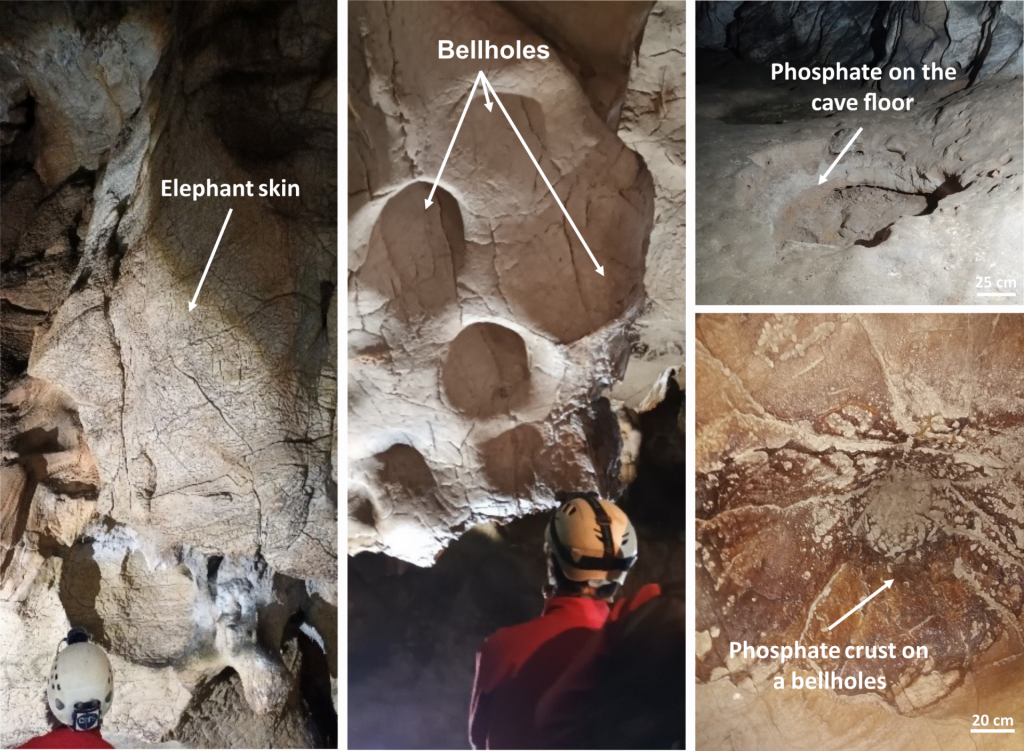
Bat occupation has proven to be a factor in the modification and alteration of caves. When bats occupy caves in large numbers, they release significant amounts of CO₂ (through respiration) and waste (guano and urine). These inputs increase the acidity of the environment and the circulating fluids, altering the cave walls and creating characteristic morphologies. Associated with these morphologies, a specific mineralogy is linked to bat waste. Over time, guano and acidic fluids mineralize into phosphates, sulphates, and nitrates. All these impacts are grouped under the process known as biocorrosion. Few studies have focused on the impacts on speleothems, raising important questions: Do bat occupation phases leave traces in speleothems? Do these traces disrupt the recorded climatic and chronological signals?
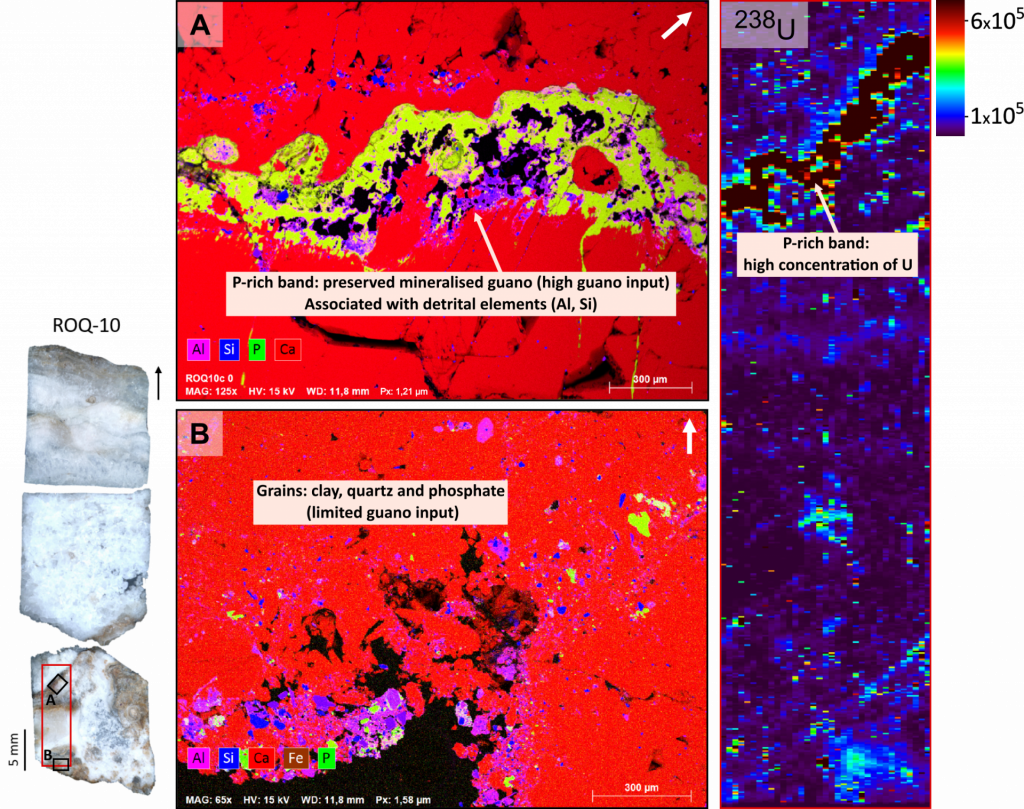
To answer these questions, we analyzed multiple samples of speleothems, guano, soil, and sediments from the Roquette Cave (Gard, France), which exhibits characteristic morphologies. The samples were analyzed using the PANOPLY platform with Fourier Transform Infrared Spectroscopy (FTIR), Scanning Electron Microscopy (SEM), and X-Ray Diffraction (XRD). Elemental maps were also created using LA-ICP-MS (ISTO, Orléans). The results revealed that bat occupation phases are preserved in speleothems as phosphate bands or grains, formed by the mineralization of fluids and guano. Systematically, these phosphates are associated with detrital elements such as quartz, clays, and oxides, introduced by bat movement and the dissolution of cave walls, which releases insoluble elements. The chemical maps showed high concentrations of uranium associated with phosphates and thorium associated with clays. These mobilizations of uranium and thorium could disrupt the U-Th chronometer used to time-calibrate environmental signals.
Reference: Cassagne H., Barbarand J., Pons-Branchu E., Nouet J., Augier R., Blaise T., Leblanc M., Bruxelles L. (2026) Petrographic, mineralogical and geochemical characteristics of speleothems after cave occupation by bats (Roquette cave, Gard, France). Sedimentary Geology, 501, 107125, doi : 10.1016/j.sedgeo.2026.107125