
Reference of the publication
Stevenard, Nathan, Aline Govin, Catherine Kissel, Didier Swingedouw, Samuel Toucanne, Nathaëlle Bouttes. « Persistent bistability of Nordic Seas overflow waters over 800,000 years ». Science Advances 12, no 45 (2026): eaee7886. https://doi.org/10.1126/sciadv.aee7886.
Motivation
The stability of the Atlantic Meridional Overturning Circulation (AMOC) is a major uncertainty in projections of future climate. However, direct evidence for AMOC tipping behavior on orbital timescales remains scarce. Here, we reconstruct the strength of Iceland-Scotland Overflow Water, a key lower branch of the deep Atlantic circulation over the past 800,000 years (Figure 1). To do so, we combined 12 current-speed records from North Atlantic sediment cores (Figure 1) with a data-driven hybrid model.
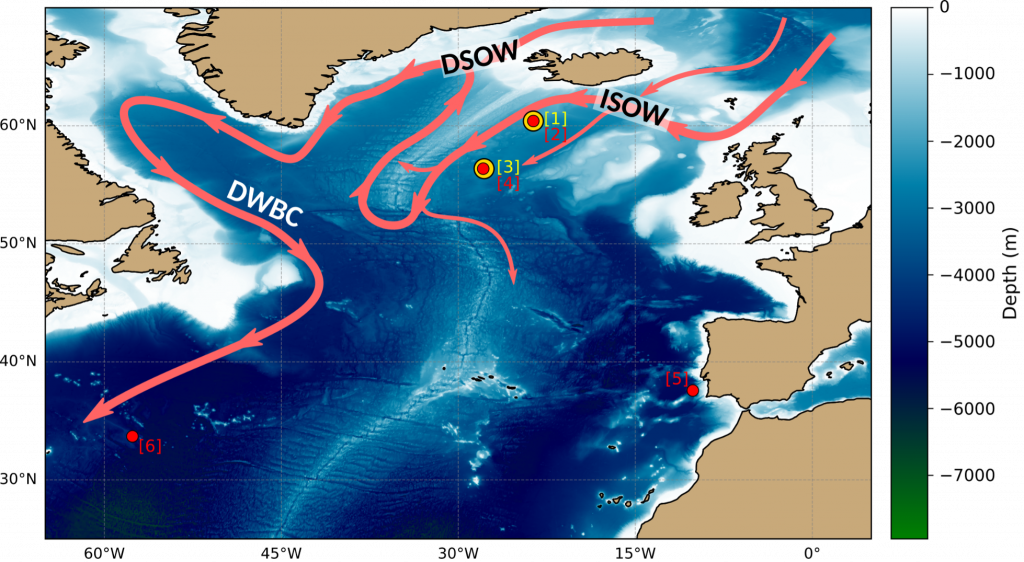
Figure 1: Bathymetry North Atlantic map bathymétrique illustrating the flowing pathway of Nordic Seas overflow waters (ISOW, Iceland-Scotland Overflow Water, et DSOW, Denmark Strait Overflow Water) which then form the Deep Western Boundary Current (DWBC). Sediment cores analyzed in this study are shown by red and yellow dots.
Main results
The resulting record of the past ISOW strength (figure 2) reveals :
(i) persistent alternation between weak (glacial) and strong (interglacial) circulation modes,
(ii) pervasive millennial-scale variability within both regimes,
and (iii) systematic asymmetry between weak-to-strong recoveries and strong-to-weak collapses.
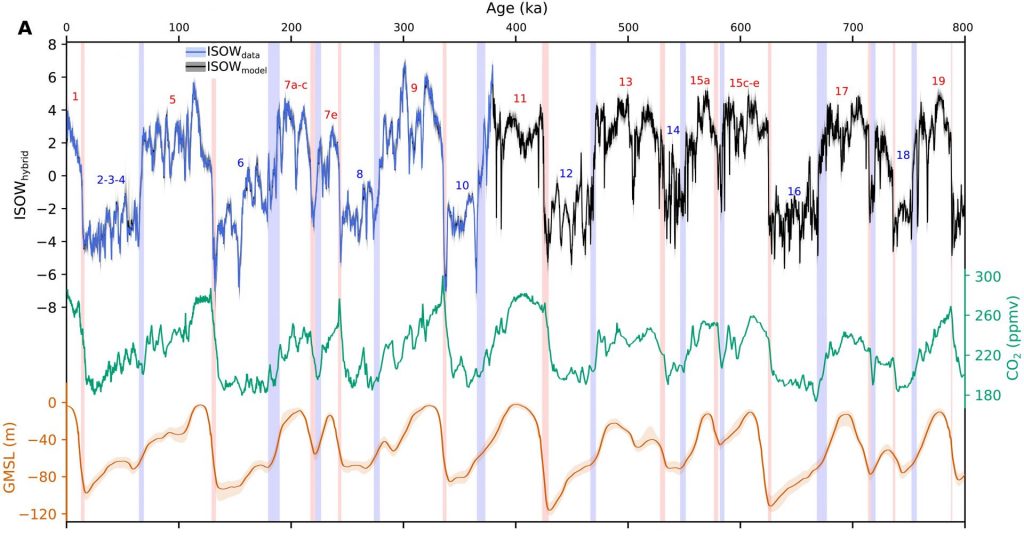
Figure 2: Variations over the last 800 000 ans (top) of the strength of Nordic Seas overflow waters (ISOW) obtained from the reconstruction (in blue, 0-400 ka) and from the data-driven hybrid model (in black, 400-800 ka), (middle) of the atmospheric CO2 concentration, and (bottom) of global mean sea level.
Threshold and phase-space analyses show that regime shifts occur within a narrow window of atmospheric CO2 and sea level and often follow hysteresis-like loops. Although bistability persists throughout the last 800,000 years, its sensitivity and timing evolve through time.
These findings provide long- term, high- resolution, data- driven constraints on the bistability of Nordic Seas overflow waters and its implications for AMOC resilience in a warming world.