
The Tibetan Plateau, also known as the Asian Water Towers, is a vital region for the water security of over two billion people in Asia. Its glaciers and snowpack, major sources of freshwater, are severely impacted by climate change, leading to accelerated glacier retreat, reduced snow cover, and changes in precipitation seasonality. While the Indian Summer Monsoon provides a significant portion of the precipitation, the westerlies dominate for 8 to 9 months a year and play a crucial, yet poorly understood, role in the hydrological cycle of Asian Water Towers. A major unresolved question remained: how does moisture transported by the westerlies interact vertically with locally recycled moisture?
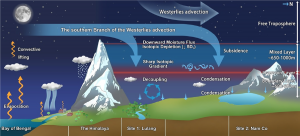
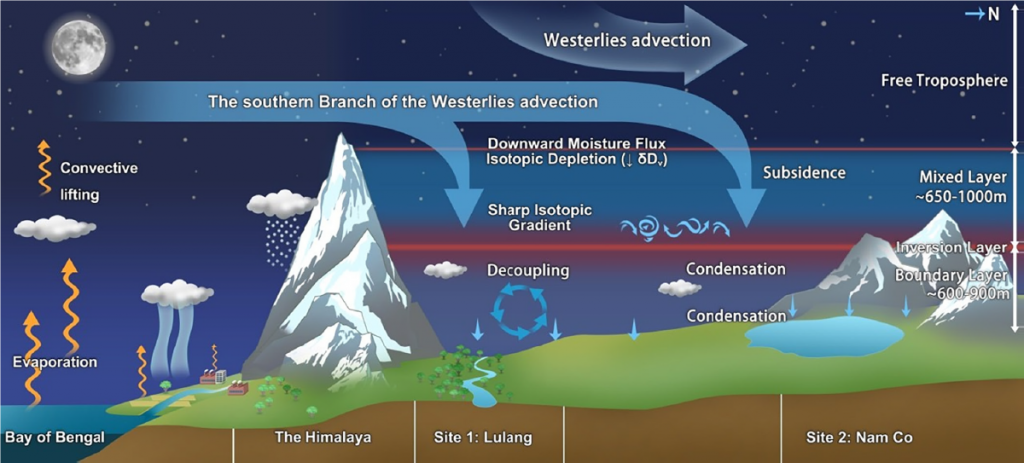
To address this, an international team, including researchers from the Laboratoire des Sciences du Climat et de l’Environnement (LSCE), conducted unprecedented observations of the isotopic composition of water vapor (δD and d-excess) and meteorological parameters at two sites in Tibet: Lulang (3,335 m) and Nam Co (4,730 m). Measurement campaigns, conducted between 2017 and 2019 during westerly-dominated periods, revealed a nocturnal vertical transport mechanism characterized by a distinct three-layer atmospheric stratification. At high altitudes, the free troposphere is dominated by moisture depleted in heavy isotopes, a signature of the westerlies. Near the surface, the atmospheric boundary layer is dominated by locally recycled moisture enriched in heavy isotopes, originating from evapotranspiration or lakes. Between them, a mixed layer acts as a buffer zone. At night, westerly subsidence (downward air movement) combined with radiative cooling creates thermal inversions that block vertical exchanges between these layers. This decoupling allows approximately 30% of the moisture transported by the westerlies to be integrated into the local hydrological cycle, even without precipitation, by supplying the boundary layer with water vapor.
This mechanism explains how the westerlies, despite often transporting moisture confined at high altitudes, can actively contribute to the local water budget of Asian Water Towers.
Gao, J. et al. Vertical conveyor driving the integration of moisture transported by the westerlies to the Asian water towers’ atmospheric water cycle. Proc. Natl. Acad. Sci. 123, e2529749123 (2026), https://doi.org/10.1073/pnas.2529749123