
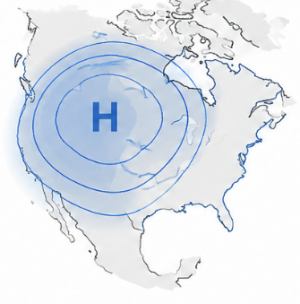
A recent attribution study led by LSCE shows that climate change substantially amplified the intensity of the exceptional early-season heatwave that affected North America in March 2026. The study also reveals that nearly 50 million people were exposed to climate-intensified heat, with most exposure occurring in the highest hazard category.
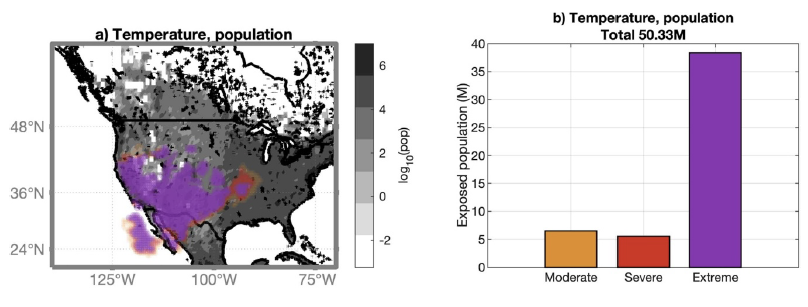
Figure: Population exposed to climate-intensified heat during the March 2026 North America heatwave. (a) Areas where statistically significant climate-change-driven warming overlaps with population density. Colours indicate moderate (98th percentile), severe (99th percentile), and extreme (99.5th percentile) heat hazard levels. (b) Total exposed population by hazard category, showing that nearly 50 million people were affected, with most exposure occurring in the most extreme class.
On March 2026, an exceptionally early and widespread heatwave affected much of western and central North America, breaking temperature records in cities including Phoenix, Las Vegas and Los Angeles. Using the ClimaMeter analogue-based attribution framework applied to ERA5 reanalysis, the study compares similar atmospheric circulation patterns observed in a cooler climate (1950–1987) with those occurring in the present climate (1988–2025). By keeping the large-scale weather pattern fixed, the analysis isolates the contribution of climate change to the event. The results show that under comparable meteorological conditions, present-day temperatures are typically 1 to 3°C warmer, with locally even larger increases. The atmospheric circulation responsible for the event remains broadly unchanged between the two periods, while natural climate variability plays only a limited role, indicating that anthropogenic climate change is the primary driver of the additional warming.
The study further combines meteorological attribution with socioeconomic exposure data, showing that nearly 50 million people and more than 2.7 trillion USD in GDP were located in areas where climate change significantly amplified the heat hazard. Most of this exposure occurred within the most extreme category of heat intensity, highlighting how global warming is increasing not only temperatures but also the number of people and economic assets exposed to dangerous heat. Davide Faranda, CNRS researcher at LSCE/IPSL, explains that persistent high-pressure systems remain the immediate cause of such heatwaves, but climate change now makes these weather patterns substantially hotter than they were only a few decades ago. Tommaso Alberti, researcher at INGV, adds that the event illustrates how anthropogenic warming is increasingly transforming early-season heatwaves into major societal hazards, well before populations and ecosystems have had time to adapt.
Article Reference:
Faranda, D., Zanchi, M., Yiou, P., Chericoni, M., Vrac, M., Tang, H., Dafis, S., Mengaldo, G., & Alberti, T. 2026. Conditional Attribution and Socioeconomic Exposure of the March 2026 North America Early Heatwave. Environmental Research Letters, 21, 144006. https://doi.org/10.1088/1748-9326/ae870d