
Understanding the impacts of permafrost thawing on the carbon cycle requires a closer look at the proportion of dissolved and particulate organic carbon released upon thaw, and the magnitude of its conversion into greenhouse gases, which remain critically underexplored.
In Central Yakutia (Siberia), we show evidence of contrasting influence of permafrost degradation on dissolved and particulate organic matter in both old and recent thermokarst lakes. Particulate organic carbon is largely modern and originates from lake primary production. In contrast, up to 75% of dissolved organic carbon originates from permafrost thaw in recent lakes and early-Holocene lakes modified by recent thermokarst, leading to the highest concentrations ever measured in such lakes.
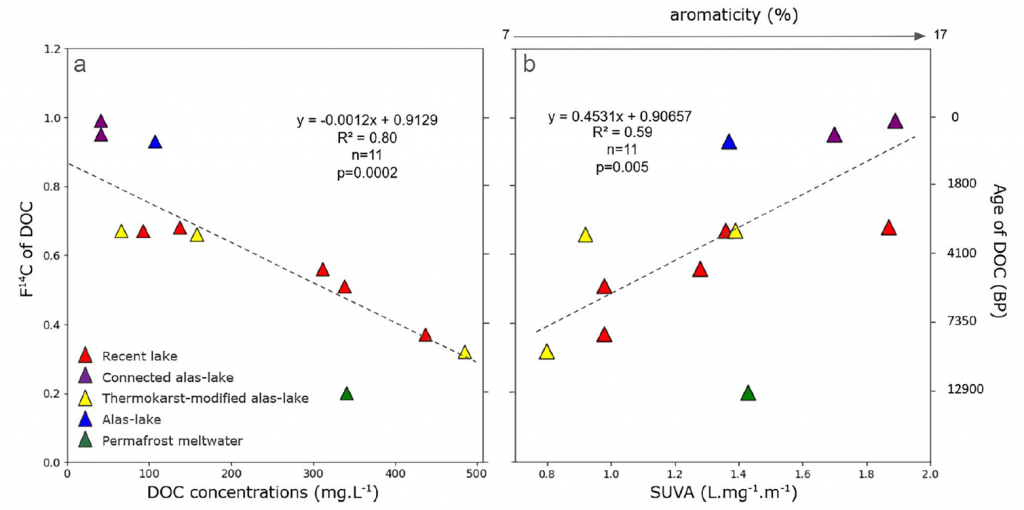
Despite massive transfers to lakes of permafrost-derived dissolved organic carbon showing high lability characteristics, this carbon fuels only a fraction of carbon dioxide emissions, and accumulates. Methane and the remaining carbon dioxide emissions originate from recently primarily produced carbon, also highly labile. The LSCE contributed to the 13C and 14C geochemistry, including the acquisition of isotopic data and their interpretation in conjunction with the other biogeochemical parameters measured in the study.
Reference: Ollivier S., Séjourné A., Hatté C., Bouchard F., Noret A., Hughes-Allen L., Costard F., Gandois L.. (2026). Massive concentrations of old dissolved organic carbon from Yedoma thaw in lakes in Siberia. Communications Earth & environment, 7, 200, doi : 10.1038/s43247-026-03229-0